In a new study, researchers from the Imperial College of London have now built a "family tree" of bacterial motors. The work was published in Scientific Reports yesterday.
By combing imaging and DNA analysis, scientists were able to understand what ancestral motors may have looked like and how they could have evolved into the sophisticated motors seen today. From this work, the group found that primitive bacterial species had around 12 stators and more sophisticated species had around 17 stators. Using DNA analysis, this suggested that ancient motors had only 12 stators.
According to researchers, the clear separation between primitive and sophisticated species is called a quantum leap. This study reveals that the increase in motor power capacity is likely the result of existing structures fusing, which provides a structural scaffold to incorporate more stators.
Using cryo-electron microscopy, the researchers were able to image flash-frozen motors inside living cells from all angles. They then built a family tree of the species using DNA sequencing data on their swimming ability and motor properties. They found that bacteria with 17 or more stators, and their relatives, had extra structures attached to their motors.
"Bacterial motors are complex machines, but with studies like this, we can see how they have evolved in distinct steps. Moreover, the 'leap' from 12 stators to 17, while a great innovation, has an aspect of 'biological inevitability' in the same way as wings, eyes, or nervous systems in higher animals: the precursors of high torque have evolved multiple times, and one set of them ended up fusing to form the scaffold we describe in our work," says lead researcher Morgan Beeby.
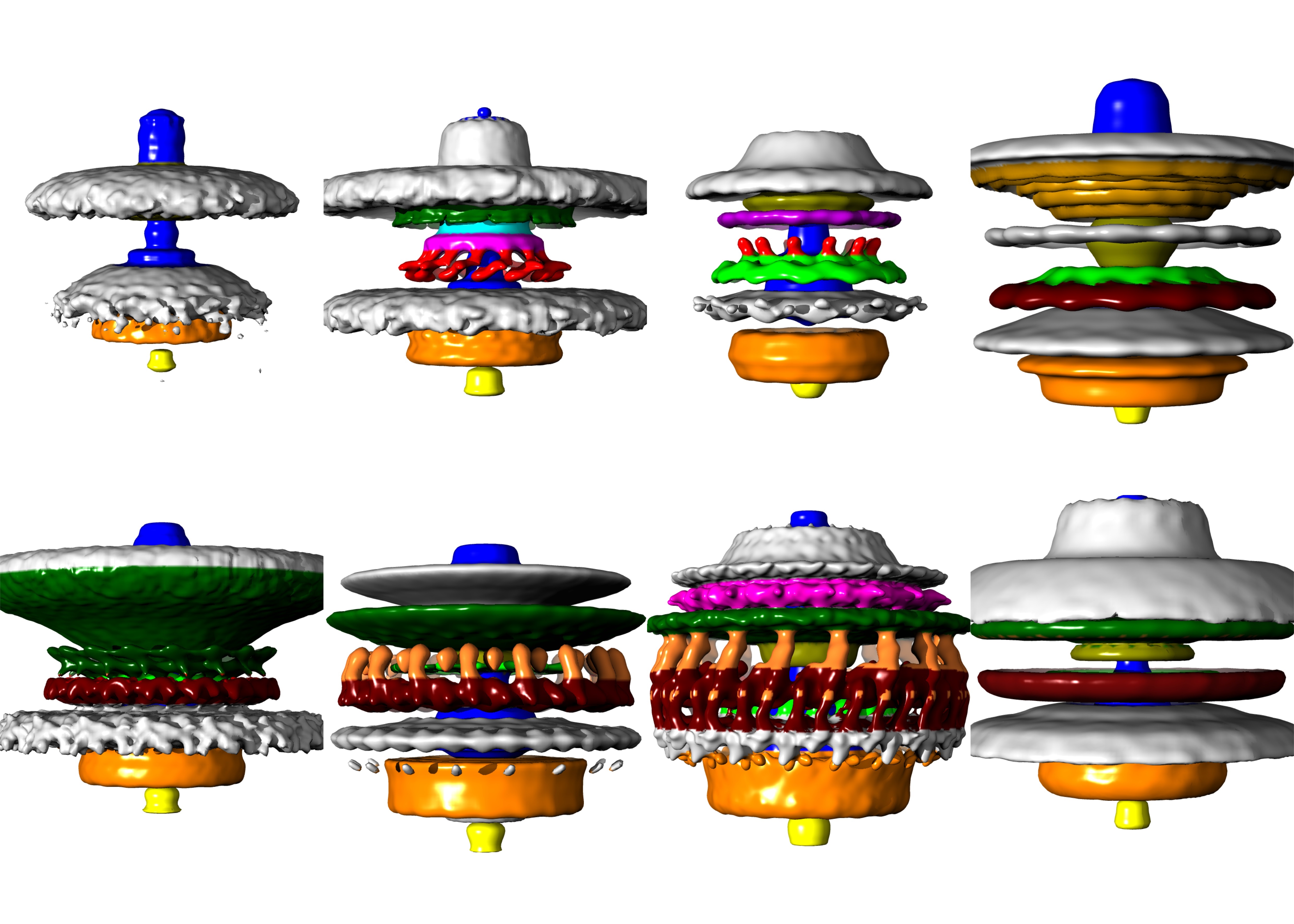 He adds, "Evolution is a creative process, often drawing on variations upon a theme. It is constantly churning out new molecular ideas, many of which fail, but inevitably some get realized multiple times. We have seen this in animals, and now we see this process in the nanoscopic world of molecular evolution too."
Image: 3D models of the eight studied bacterial motors. Image courtesy of Morgan Beeby at the Imperial College London.