Human genome sequencing has made it possible for scientists to suggest potential disorders even before there are identified patients. In 2012, doctors found consistent symptoms of progressive blindness in three families, and a defect in a candidate gene was proposed. Patients harboring such a defect have not been identified, until now. A team of researchers from Hebrew University Medical Center and Bielefeld University in a recent study have identified both the defect and the afflicted.
 The team performed whole-exome and genome sequencing of five patients from three families that suffered from distinctive vision and hearing loss. All shared a particular ring-shaped damage in the retina as well as moderate to severe hearing loss that begin emerge at around 40 years of age. Sequencing results pointed to a variant mutation that affects the catalytic active site of the enzyme arylsulfatase G (ARSG).
In vitro functional assays with mutant and wild-type ARSG proteins showed that the defect causes an inability to break down the carbohydrate heparan sulfate. As a result, heparan sulfate accumulates in lysosome, enlarging the organelle until it leads to cell death. This destruction brings about the disorder. The team’s paper, published recently in Nature Genetics in Medicine, concludes that homozygosity for the ARSG variant results in an atypical combination of late-onset Usher syndrome.
Due to the late onset of the disease, diagnosis has to be done through genetic testing so that treatment can commence before irreparable damage. “Further patients should be found particularly among the unexplained cases with Usher syndrome. This indicates a combined loss of vision and hearing,” says senior author Thomas Dierks.
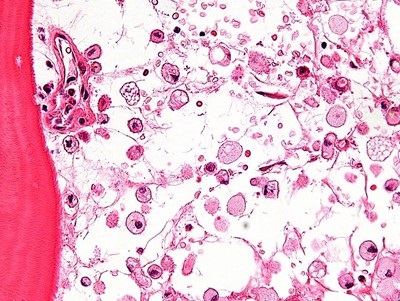
Image: Gaucher disease, a type of lysosomal storage disease, features cells with characteristic crumpled tissue-like cytoplasms. Image courtesy of Nephron, Wikimedia Commons.