A fundamental advance in the quality of an optical material used in hyperlensing could enable the development of an optical lens so powerful that users could view features the size of a small virus on the surface of a living cell in its natural environment.
The development was reported today in a Nature Materials paper by a team of researchers led by Joshua Caldwell, associate professor of mechanical engineering at Vanderbilt University.
The optical material involved is hexagonal boron nitride (hBN), a natural crystal with hyperlensing properties. Hyperlensing is a method of creating lenses that can resolve objects much smaller than the wavelength of light.
The best previously reported resolution using hBN was an object about 36 times smaller than the infrared wavelength used. This new paper describes improvements in the quality of the crystal that enhance its potential imaging capability by about a factor of ten.
The researchers achieved this enhancement by making hBN crystals using isotopically purified boron. Natural boron contains two isotopes that differ in weight by about 10 percent, a combination that significantly degrades the crystal's optical properties in the infrared.
"We have demonstrated that the inherent efficiency limitations of hyperlenses can be overcome through isotopic engineering," said team member Alexander Giles, research physicist at the U.S. Naval Research Laboratory. "Controlling and manipulating light at nanoscale dimensions is notoriously difficult and inefficient. Our work provides a new path forward for the next generation of materials and devices."
The researchers calculate that a lens made from their purified crystal can in principle capture images of objects as small as 30 nanometers in size. To put this in perspective, there are 25 million nanometers in an inch and human hair ranges from 80,000 to 100,000 nanometers in diameter. A human red blood cell is about 9,000 nanometers and viruses range from 20 to 400 nanometers.
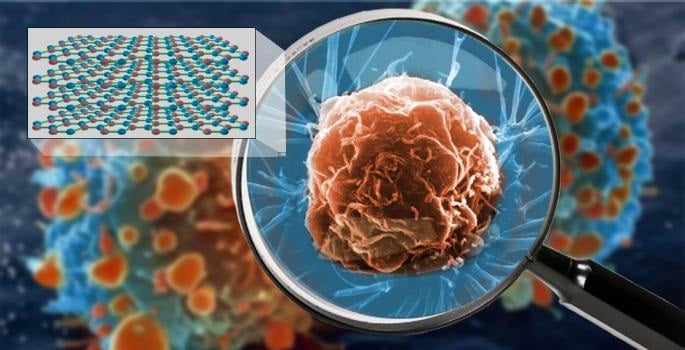
Over the years, scientists have developed many instruments capable of producing images with nanoscale resolution, such as electron-based and atomic-force microscopes. However, they are incompatible with living organisms: either they operate under a high vacuum, expose samples to harmful levels of radiation, require lethal sample preparation techniques like freeze drying, or remove samples from their natural, solution-based environment.
Image: A new hyperlens crystal is capable of resolving details as small as a virus on the surface of living cells. The atomic structure of the hexagonal boron nitride crystal is shown in the cutout. Image courtesy ofKeith Wood, Vanderbilt University.