Age-related stem cell loss has been shown in mice to be prevented by inhibiting mTORC1, one of the complexes in the mTOR signaling pathway. The mTOR pathway is known to play a crucial role in cellular growth and proliferation. Researchers from the Buck Institute discovered that TOR also has a key role in the loss of adult stem cells. The findings were recently published in Cell Stem Cell.
When infection or injury occurs, quiescent adult stem cells divide quickly and some differentiate into other cell types to repair the damaged tissue. Some stem cells remain in order to fight future tissue damage but stem cell loss overall increases as we age. The study showed that when responding to injury, somatic stem cells transiently activate mTORC1 signaling during tissue regeneration and repeated regenerative episodes result in the loss of stem cells. However, age-related stem cell loss was shown to be reduced with long-term rapamycin treatment, which inhibits the mTOR pathway.
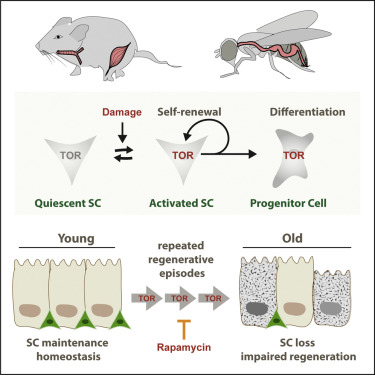 "It's all about maintaining a balance between stem cell renewal and differentiation," said Heinrich Jasper, PhD, Buck professor and senior author on the paper. "It's easy to see how a loss of adult stem cells might accrue over a lifetime and accelerate with aging. We are excited to have a means of rescuing stem cells, boosting their ability to maintain healthy tissue."
The team plans to further investigate why rapamycin treatment resulted in a recovery of stem cells in mice and to better understand how the signaling pathway is controlled in stem cells. One possibility is that TOR is increased over our lifetimes but it could also be that activation gets stronger as we age.