Researchers at the Perelman School of Medicine at the University of Pennsylvania have found that DNA sequences between mitochondria within a single cell are vastly different. The work was published yesterday in Cell Reports.
Mitochondria are often considered the powerhouse of the cell. They have their own DNA (mtDNA) and produce energy for the body. A single mitochondrion can contain 10 or more different genomes with hundreds to thousands of individual mitochondria residing in each cell. Often enough though, mutations can in these mitochondria leading to a number of disease like colorectal cancer.
In the lab of the senior author, James Eberwine, Ph.D., researchers extracted single mitochondrion and pulled out its mtDNA. They compared the mutations in a single mitochondrion from a mouse and human neurons. Interestingly, they found that mutations occurred at a different rate in mice than humans. Eberwine notes that it's important to ensure that mitochondrial diseases or potential therapeutics in cells are examined in models where the mutations parallel those that occur in humans.
The study also looked at the similarities and differences in discrete mtDNA in the same cell and also between cell types such as neurons and astrocytes in the brain. With the capability of being able to look at single mitochondrion and compare mutational dynamics between mitochondria, scientists will be able to gauge the risk for reaching a threshold for diseases associated with increasing numbers of mitochondrial mutations.
 Eberwine's group now plans to find ways to slow the rate of mtDNA mutation accumulation to hopefully stop a disease from progressing. "This roadmap of the location and number of mutations within the DNA of a mitochondrion and across all of a cell's mitochondria is where we need to start," Eberwine said.
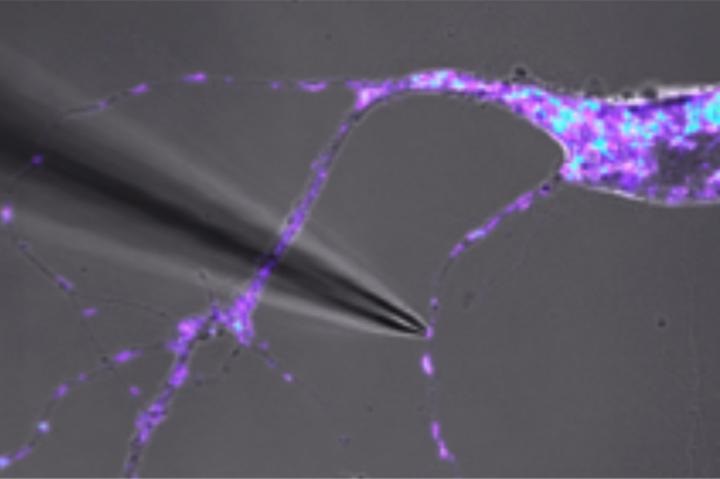
Image: Manual isolation of a single live mitochondria. The mitochondria can be seen under a microscope where a thin glass tube can be used to isolate the mitochondria from the dendrite region of the mouse neuron. Image courtesy of Jacqueline Morris and Jaehee Lee, Perelman School of Medicine, University of Pennsylvania.