Imaging mass spectrometry [time of flight secondary ion mas spectrometry (ToF-SIMS)] was successfully used to investigate the penetration and distribution of nickel in human skin in a proof-of-concept study.
Also called chemical imaging, this method involves the use of a laser or ion beam to analyze the sections of skin. Every dot, or pixel, of the section that the beam strikes provides information, which is used to classify the chemicals present in the skin according to molecular weight. The chemical information from each dot can then be combined into a digital image that shows the distribution of a substance in the skin. Chemical imaging allows all layers of the skin to be seen and the presence of virtually any substance in any part of the skin to be measured with a very high degree of precision.
Using chemical imaging to examine skin could reduce the number of animal experiments while providing new opportunities to develop pharmaceuticals, according to chemists Per Malmberg, at Chalmers University of Technology, and Lina Hagvall, at the University of Gothenburg, whose research was published last week in Contact Dermatitis.
"With pharmaceuticals you often want as much as possible of the dose to be absorbed by the skin, but in some cases you may not want skin absorption, such as when you apply a sunscreen, which needs to remain on the surface of the skin and not penetrate it. Our method allows you to design pharmaceuticals according to the way you want the substance to be absorbed by the skin," says Hagvall.
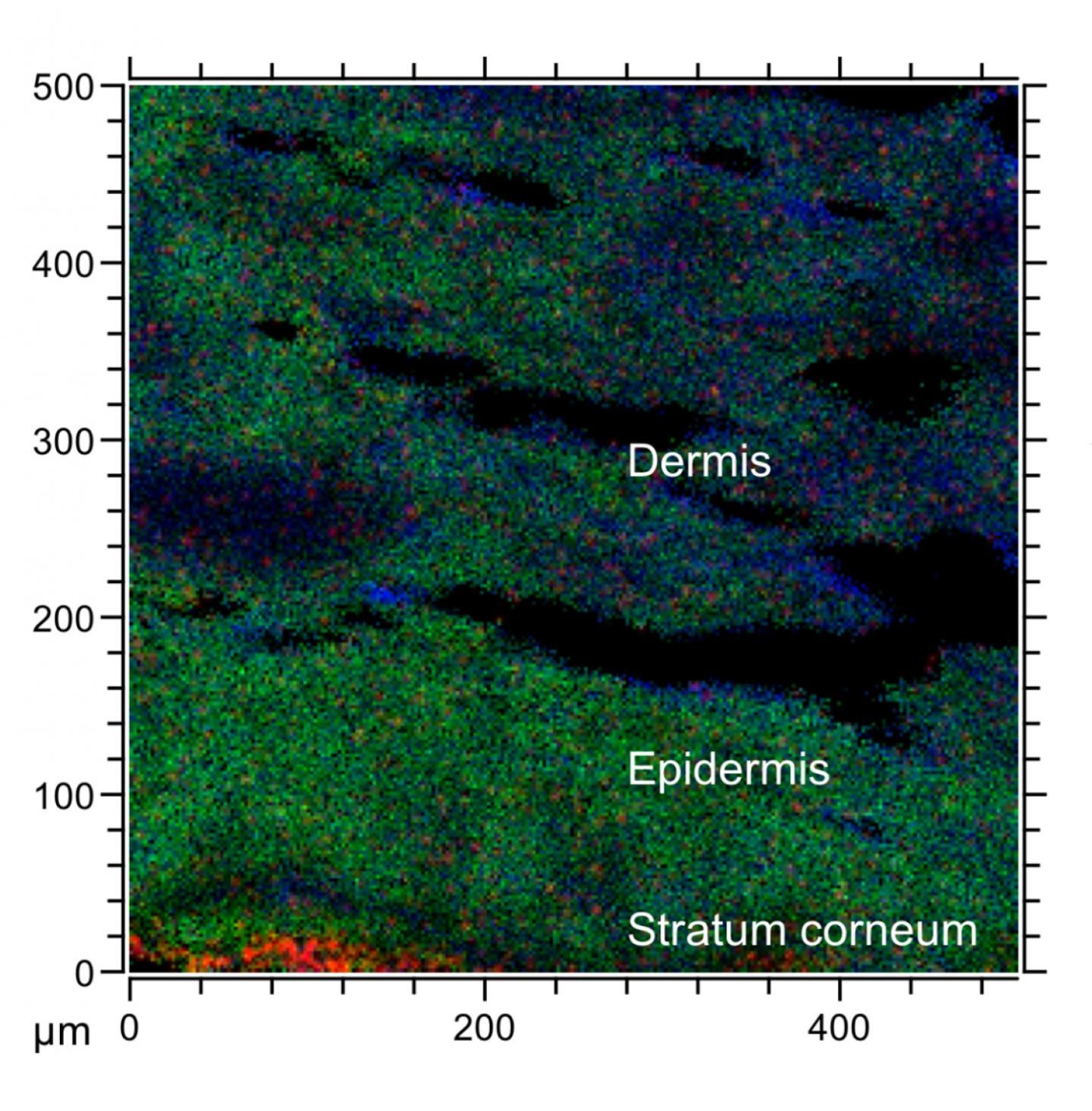
The new method can also provide a basis for determining the correct limits for harmful levels of substances that may come into contact with the skin. In order to establish those limits, you need to know how much of the dose on the skin's surface penetrates into and through the skin, which this method can show.
"Our method can show everything with an image, whether you are looking for nickel, phthalates, or parabens in the skin, or if you want to follow the drug's path through the skin. With just a skin sample we can essentially search for any molecules. We don't need to adapt the method in advance to what we are looking for," adds Malmberg.
Image: This is a 3D imaging of a skin section in which the nickel content is being measured. The red area represents the presence of nickel. Image courtesy of Per Malmberg.