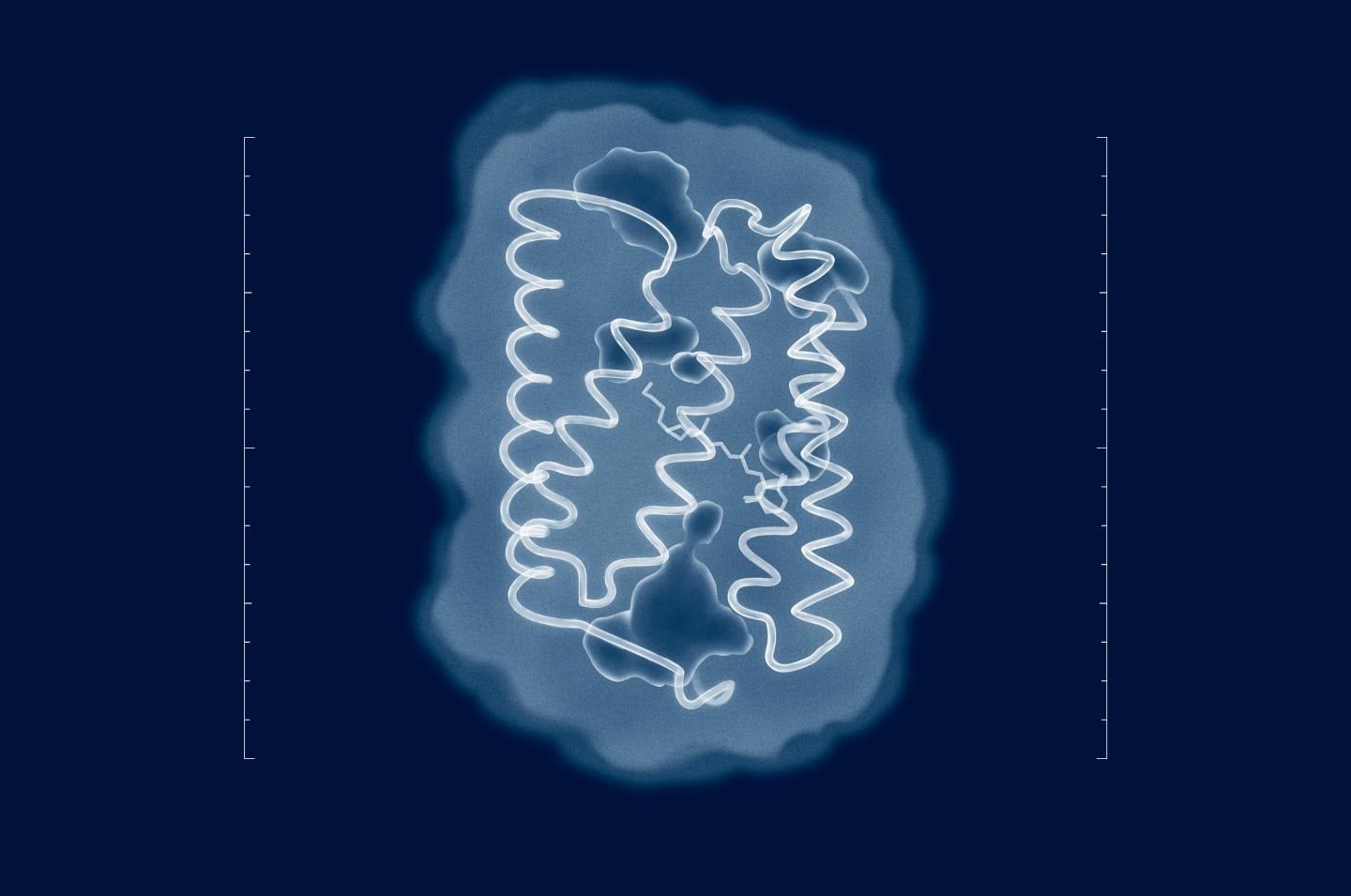
The high-resolution structure of channelrhodopsin 2, which is widely used in optogenetics, has been determined. This discovery has the potential to make the engineering of enhanced optogenetic tools more efficient.
This research was conducted by an international team from the Moscow Institute of Physics and Technology, Forschungszentrum Jülich, the European Synchrotron Radiation Facility, the Institut de Biologie Structurale, and the Max Planck Institute of Biophysics and published in Science last week.
"Attempts to solve the structure of ChR2 go right back to the time of its discovery in 2003. But despite the efforts of numerous research groups from across the world, the structure of the protein in its natural state has remained unknown," says Valentin Borshchevskiy, one of the authors of the paper and deputy head of the Laboratory for Advanced Studies of Membrane Proteins at MIPT. "Now that we have the structure, meaningful mutations can be introduced into the protein to adjust its properties to the requirements of a specific experiment. Not knowing the structure, we had to tediously work out the useful mutations by trial and error or make do with the data on related proteins."
Channelrhodopsin 2, or ChR2, is a light-sensitive protein that was originally extracted in 2003 from Chlamydomonas reinhardtii. Scientists can insert ChR2 into the membrane of a living cell to control it. When illuminated, this protein allows positively charged ions to pass into the cell through the cell membrane. In a nerve cell, this depolarizes the membrane, mimicking the effect of a nerve impulse and causing this particular neuron to fire.
Because ChR2 works fast and is relatively harmless to cells, it is the current go-to solution for nerve cell activation. A range of artificially induced mutations are available for altering the protein's properties. For example, it is possible to increase the current it generates or alter the wavelength of light it responds to. Such modifications enable experimenters to work with proteins tailored to their needs. Researchers can even combine several protein variants for a distinct response at various wavelengths of light.
Image: Now that researchers have the structure, meaningful mutations can be introduced into the protein to adjust its properties to the requirements of a specific experiment. Image courtesy of MIPT Press Office.