The mass of the basic living cell is mostly determined by the amount of water, proteins, lipids, carbohydrates, and nucleic acids that comprise the cell. This mass is also tightly linked to the cell’s metabolism, proliferation, gene expression, and most importantly, the state and well-being of the greater organism. For the first time, a team from Eidgenössische Technische Hochschule (ETH) Zürich, Switzerland demonstrates the ability to track the masses of individual cells at resolutions necessary to observe cellular processes that happen in real-time.
In their publication released today in Nature, the team introduces a “picobalance” that measures the total mass of a single cell (or multiple cells) living in culture over days with millisecond time resolution and picogram mass sensitivity. The balance features a tiny, wafer-thin, transparent silicon weighing arm coated with collagen or fibronectin, that is lowered to pick up a cell.
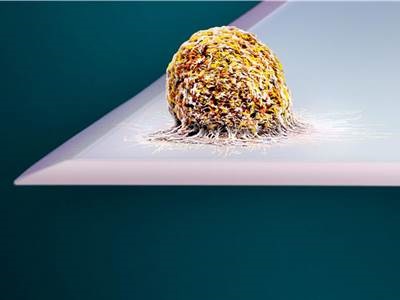 "The cell hangs on the underside of a tiny cantilever for the measurements," says doctoral student Gotthold Fläschner, who co-invented and conducted most experiments using the new scale.
This cantilever measures through laser-induced oscillations. A pulsing blue laser at the fixed end triggers a slight oscillation of at the other end where the cell hangs. The mass can be calculated from measuring the oscillations from before and after the cell is picked up. Moreover, the changing weight is shown as a curve, allowing readings to be shown over the whole measuring period—from milliseconds to days. The balance is also compatible with high-performance microscopy enabling concurrent visual observation of the cells internal processes.
In observing a mammalian cell throughout its cell cycle, the team finds that its mass fluctuates intrinsically by around 1-4% over timescales of seconds. Perturbation experiments link these fluctuations to the basic cellular processes of ATP synthesis and water transport. These fluctuations remain detectable even when cells are infected with a virus and growth and the cell cycle is halted. Only in cell death do the changes in mass finally cease.
"We're seeing things that nobody else has yet observed,” says Fläschner.
The authors anticipate that their approach will contribute to the understanding of cell mass regulation in various time scales and conditions, important in areas including physiology, cancer, stem cell biology and drug discovery. "A cell's mass is a very good indicator of its physiology," explains first author David Martínez-Martín.
Image: A human cell is attached to a highly sensitive cantilever. Image courtesy of Martin Oeggerli / ETH Zurich / University of Basel.