Apparently, DNA is more than just the backbone of cellular genetic information. Chemists at The Scripps Research Institute (TSRI) have described a method for repurposing DNA as a backbone for creating novel and biologically functional hydrogels.
These findings build on the previous work of Floyd Romesberg and Tingjian Chen, who last year had developed an artificial DNA polymerase with unique capabilities. Named SFM4-3, this enzyme can synthesize DNA chains with functional groups, such as fluorine (F) or methoxy groups (O-CH3), attached to the sugar backbone. These modifications have been designed with the aim to improve the properties of DNA-based drugs.
In this new study, the same team has managed to attach azido groups (-N3) to the DNA using modified nucleotides. Azido groups are particularly known for “click chemistry” techniques that allow convenient attachment of other compounds to DNA and peptides. PCR amplification using SFM4-3 thus produces azido-modified DNA segments capable of “clicking” to a wide variety of different molecules.
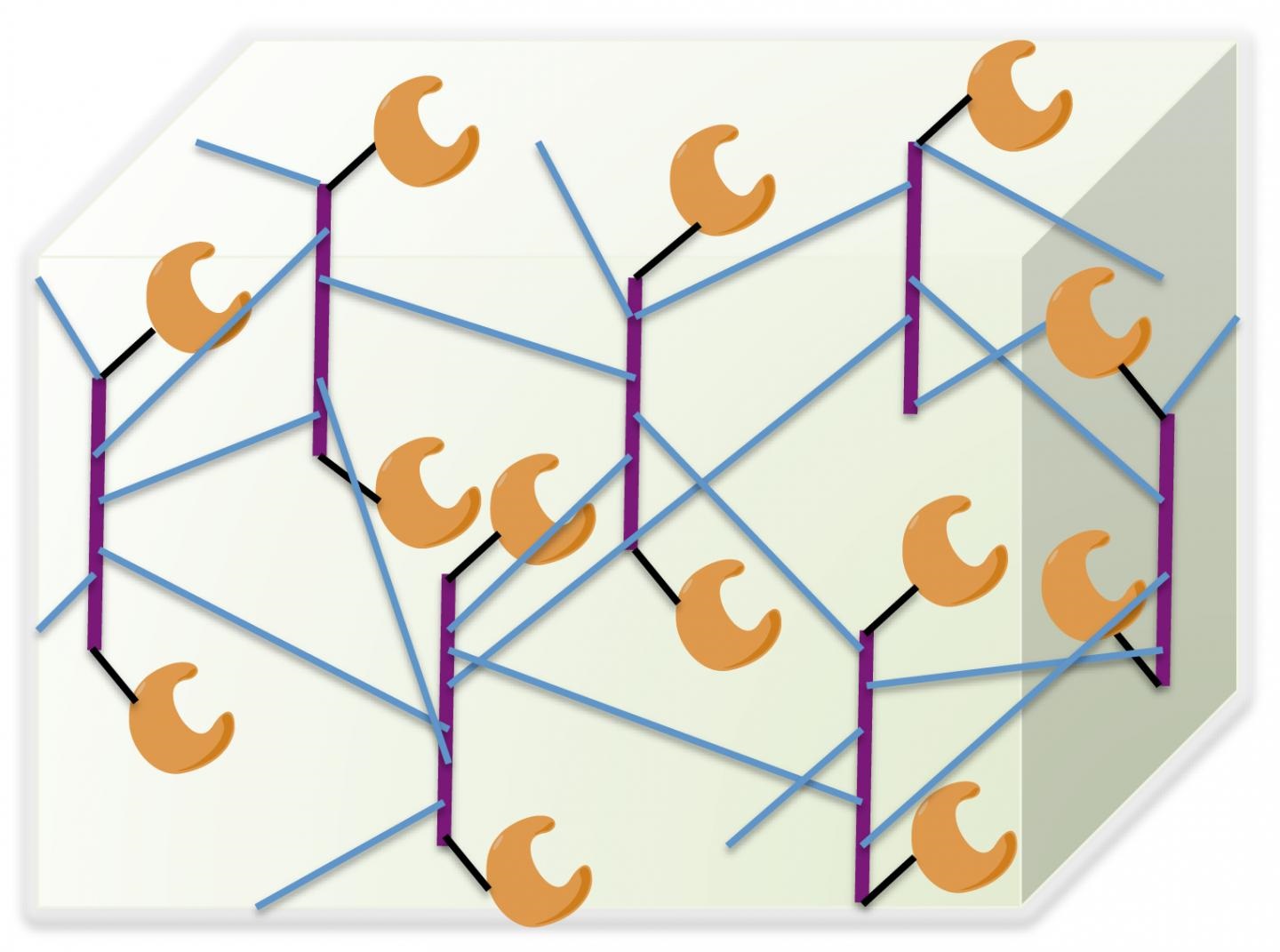
Next, using click chemistry the duo fastens multiple DNA strands to a central, azido-modified DNA strand, creating a "bottle brush" structure. Further DNA synthesis with PCR results in the creation of a large mesh of DNA that surprisingly forms a hydrogel upon exposure to water.
"Hydrogels are a focus of great interest these days because they have a lot of potential applications, though there are relatively few ways for their controlled production," Romesberg said.
Intriguingly, incubation with a restriction endonuclease results in an effective dissolution of the hydrogel. Transfer of the dissolved DNA into a structured environment and addition of DNA ligase later reforms the hydrogel, taking the shape of its new structure. The team concludes that this hydrogel may then be easily molded and remolded into different controlled architectures under physiological conditions.
"We think this hydrogel can have applications ranging from novel forms of drug delivery to the growing of cells in three-dimensional cultures," Chen said.
Apart from azido groups, the team has also demonstrated using the SFM4-3 polymerase to add other modifications, chloro (Cl), amino (NH2), and an arabinose substitute, to the DNA backbone. And they are looking for more.
More importantly, the team is pursuing the discovery of new applications for the DNA modifications, including the hydrogels. "Given that DNA can have different sequences that impart different properties, we can even start to think about evolving nanomaterials with desired activities," Romesberg said.
The study was published earlier this week in the chemistry journal Angewandte Chemie.
Image: Diagram of enzyme (orange) encapsulating 2'-azido-DNA/DNA hydrogel. Image courtesy of Romesberg Lab.