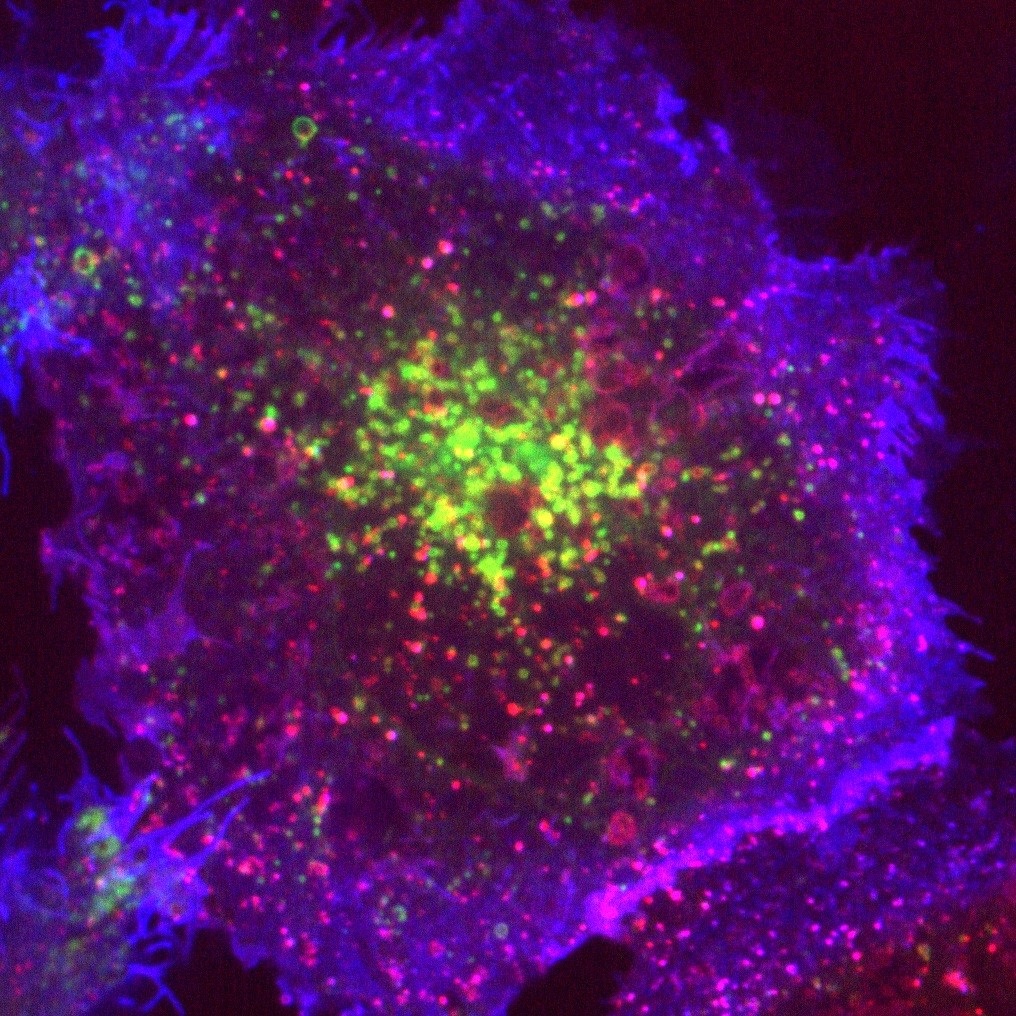
 A team at Warwick Medical School, University of Warwick, has managed to trigger clathrin-mediated endocytosis in the lab. They did it by using a chemical rapamycin which diffuses into the cell allowing them to trigger endocytosis to occur all over the cell. The work was published earlier this week in The Journal of Cell Biology.
Endocytosis plays a role in cell-to-cell communication, cell movements, growth and more. The scientists report that cell biologists have studied this process extensively, but haven't figured out to control the process until now.
"To trigger endocytosis we used the cell's own proteins, but we modified them. We chopped out all the unnecessary parts and just left the bare essentials. We call the process of triggering endocytosis 'hot-wiring' because it is similar to just twisting the wires together rather than having a key," says Stephen Royle, Ph.D., reader and senior Cancer Research UK fellow at Warwick Medical School.
The scientists were also able to figure out where the endocytosis was going to occur in a cell by engineering a light-sensitive version of their system that used a blue light to trigger endocytosis. Whereas the chemical across the cell the light can be focused in a narrow region causing endocytosis to be triggered only in that region. This allows the team to control where, as well as when, a vesicle that carries nutrients will form.
With this new method, scientists will be able to study the timing of endocytosis and what proteins are required. Perhaps one day, scientists may be able to "force feed" cells whatever they want if they are not actively taken up by the cell.
Image: The pinky-purple spots are the endocytic vesicles made by the hot-wiring process. Image courtesy of Gabrielle Larocque.