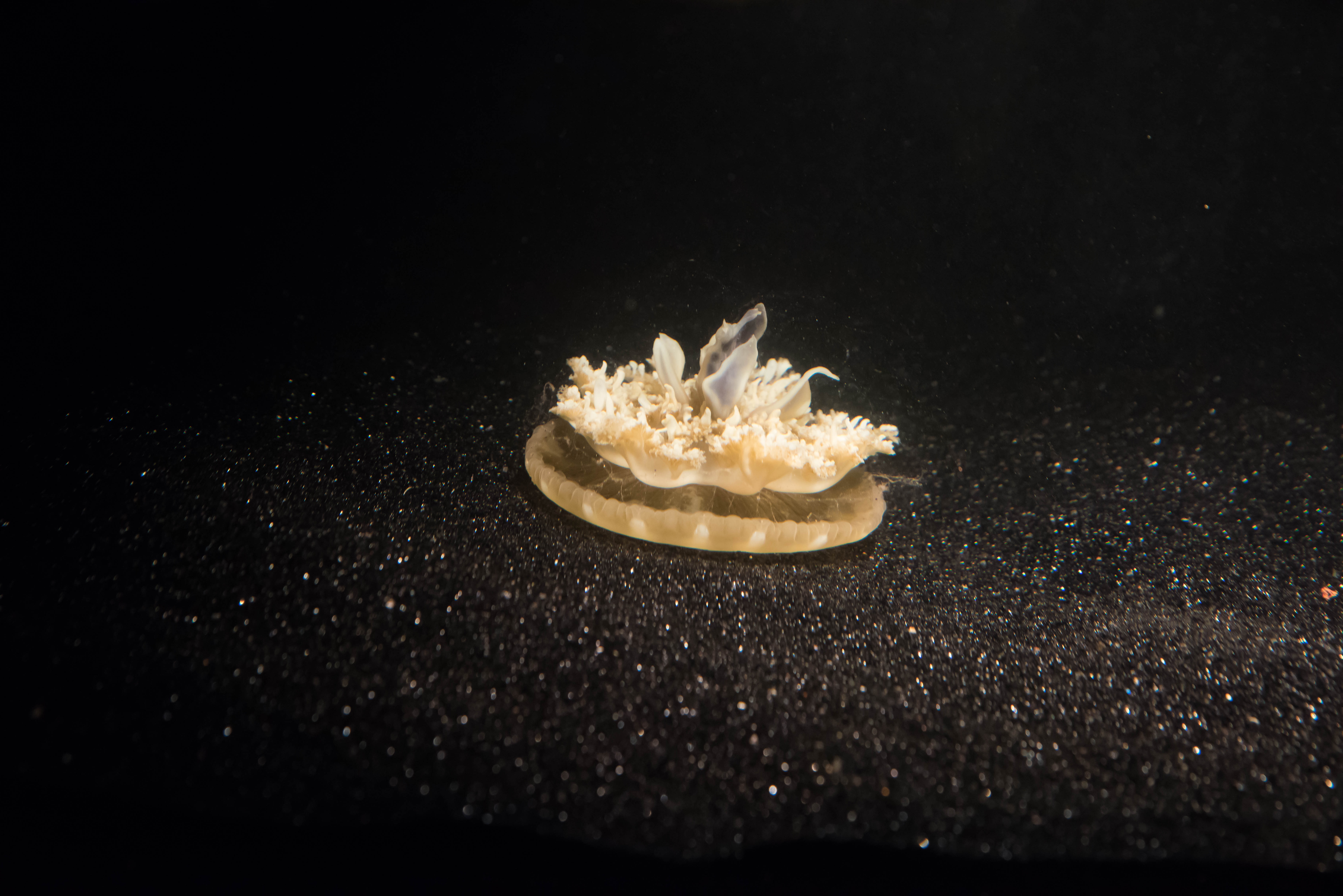
 Caltech scientists report that Cassiopea jellyfish exhibit sleep-like behavior during the night, showing reduced responsiveness to stimuli during their quiescent state.
"It may not seem surprising that jellyfish sleep, after all, mammals sleep, and other invertebrates such as worms and fruit flies sleep," says Ravi Nath, co-first author of a recent Current Biology paper and a graduate student in Paul Sternberg’s laboratory at Caltech. "But jellyfish are the most evolutionarily ancient animals known to sleep. This finding opens up many more questions: Is sleep the property of neurons? And perhaps a more far-fetched question: Do plants sleep?"
In order to be considered "sleeping," an organism must meet three critical criteria. First, it must demonstrate a period of quiescence. Second, the organism must exhibit a decreased response to otherwise-arousing stimuli while in the quiescent state. Finally, the organism must show an increased sleep drive when it is deprived of sleep.
To demonstrate quiescence, the team set up a system of cameras to monitor the jellyfish around the clock. They discovered that the jellyfish go through periods of inactivity at night, only pulsing about 39 times per minute, compared to about 58 times per minute during the day.
To prove that the animals had an increased arousal threshold during this period of decreased activity, the team set a jellyfish on a platform higher up in the tank and pulled the platform out from underneath the animal once the jellyfish showed signs of quiescence. Normally, an alert jellyfish would immediately swim to the bottom of the tank. But the jellyfish in a sleep state floated in the water for up to five seconds before "waking up" and reorienting itself.
Finally, the researchers pulsed water at the animals every 10 seconds for 20 minutes, effectively "poking" them to keep them awake. They then observed that the jellyfish were more likely to fall into the quiescent state during the day, when they would normally be active.
Though this work demonstrates that jellyfish exhibit sleep behavior, the genetic mechanisms that underlie sleep remain unknown.
"Many animals have the same genes that govern sleep," says Michael Abrams, co-first author and a graduate student in Lea Goentoro’s laboratory. "Though it was beyond the scope of our project to measure gene expression in jellyfish, we tested the effects of compounds that in other animals are known to promote sleep, such as melatonin. We found that these compounds did affect jellyfish sleep in the predicted ways, suggesting that their underlying sleep mechanism is similar to those of other organisms, including humans."
Image: A Cassiopea jellyfish rests upside-down on black sand and pulses, rhythmically contracting and relaxing its bell. At night, Cassiopea jellies pulse less frequently, a clue that they're sleeping. Image courtesy of Caltech.