 Salk Institute scientists found that a tiny protein called CYREN helps cells choose the right DNA repair pathway at the right time. The work helps provide some clarity about DNA repair and possibly has provided a tool that could combat cancer. The work appeared yesterday in Nature.
There are two different pathways that double-strand DNA breaks could be repaired. One is called NHEJ (non-homologous end joining) and is pretty fast, but error-prone. The other way is called HR (homologous recombination) and is slower, but error-free. NHEJ only operates before DNA is copied and HR acts after copying. Given that, the fast pathway operates exclusively before DNA is copied, though its machinery is so efficient and prolific that scientists have wondered why it doesn't outcompete the slower, more-exact pathway after copying, too.
In this study, the scientists found that a microprotein called CYREN, inhibited the faster pathway when a DNA copy is available for the slower pathway to use. Earlier research from a group led by Alan Saghatelian, Ph.D., a Salk professor, suggested that CYREN was interacting with the master switch of the faster pathway, a protein called Ku.
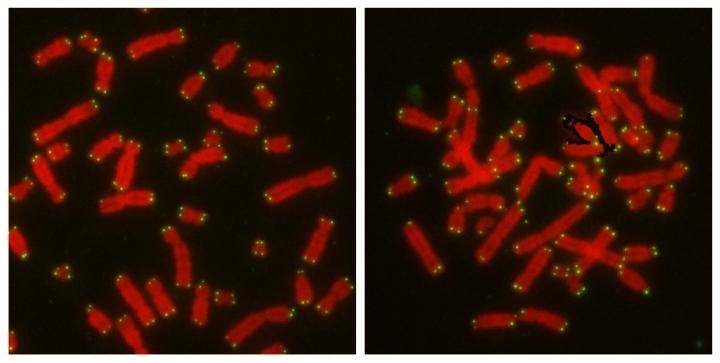
Jan Karlseder, Ph.D., a professor in Salk's Molecular and Cell Biology Laboratory and the senior author of the new paper, and his team worked with a region of the genome where repair is normally suppressed to prevent dangerous fusions to determine the interaction between Ku and CYREN. The researchers then artificially disturbed telomeres to activate the fast pathway, making it a model system to test CYREN's effects. When they did this, they found that with CYREN present, no repairs occurred after the cell copies its DNA, suggesting that it does flip off the master switch, Ku. Without CYREN around, Ku's fast pathway was active both before DNA was copied and after.
To study the competition between the fast and slow pathways, Nausica Arnoult, a Salk research associate and first author of the paper, compared repair in living cells with and without CYREN. She combined CRISPR with genes for fluorescent proteins that would be triggered by repair so that she could cut DNA in specific ways and be able to observe that the pathway had made a repair. She also analyzed the protein interactions that took place.
From these experiments, it was revealed that CYREN directed attaches to Ku to inhibit the fast pathway both depending on timing (before or after DNA copying) and the type of DNA break (smooth versus jagged, for example). Its activity can even tune the ratio of fast to slow repairs.
"Our study shows that CYREN is an important regulator of DNA-repair-pathway choice. The work also points to the exciting possibility of potentially introducing DNA damage in cancer cells and using CYREN to prevent them from making repairs," says Karlseder.
Image: Salk scientists discover that CYREN microprotein helps cells choose best path to repair genes and avoid cancer. Left: Chromosomes (red) with telomeres (green) that are undisturbed remain pristine and separate. Right: when CYREN is absent, chromosomes that have been disturbed to artificially trigger NHEJ show fusions that are characteristic of repair after DNA is copied. Image courtesy of the Salk Institute.