A new study led by scientists at the Babraham Institute identifies Tia1 as an important protein that stops our body's defenses from turning against us.
The study, published today in Nature Communications, explains that standard repair processes are too slow for B cells, where intentional DNA damage is more severe. The results show that B cells plan ahead, priming the DNA repair process early, so when they intentionally damage their own DNA it can be fixed before it causes lasting harm.
As the paper's first author, Dr Manuel Díaz-Muñoz said: "B cells walk a fine line, some DNA damage is needed for them to make effective antibodies to fight infections, but too much and they become harmful. It's a tough situation to manage biochemically. Tia1 controls the production of a number of proteins that help cells respond to damaged DNA. Tia1 allows a rapid response from B cells so they can repair DNA damage at a moment's notice."
Scientists believed that B cells only turn on DNA repair genes when they are needed to repair damage. Yet, these new results completely change this view. These genes are constantly active, but cells only use the information in these genes to make proteins when there is a lot of DNA damage. B cells prepare templates for the proteins but don't go on to make the proteins themselves.
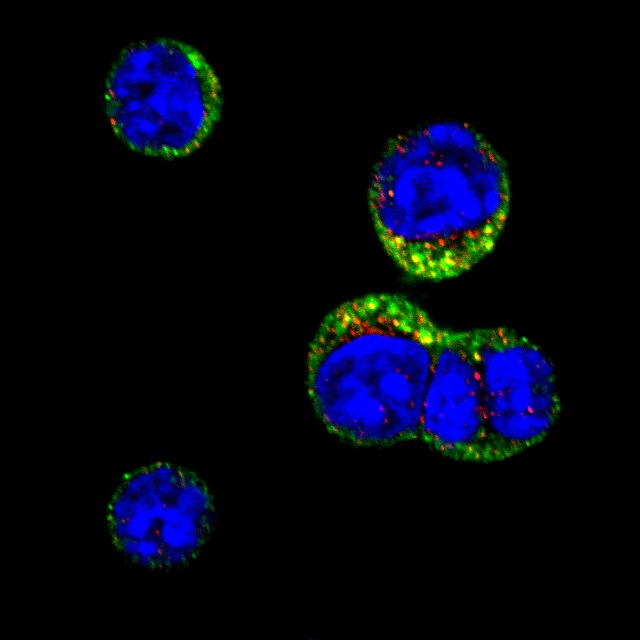
Tia1 is the protein that enables B cells to stop making DNA repair proteins part way through. When DNA damage is low, Tia1 gathers together the protein templates, or mRNAs, for lots of different DNA repair proteins. When DNA damage increases Tia1 can quickly release all the mRNAs it collected and the cell uses them to make lots of the proteins it needs to fix its genes.
Head of the Lymphocyte Signalling Programme at the Babraham Institute and senior scientist on the paper, Dr Martin Turner, said: "Remarkably, our data suggest that regulation of mRNAs by Tia1 rather than protein destruction controls DNA repair in activated B cells. This is an attractive and little explored mechanism that we are now starting to understand. Controlling protein production in this way is important in other healthy and diseased cells and it will be interesting to see if a similar system exists in other places."
Image: A microscopy image showing collections of mRNA molecules, called RNA granules (green), inside B cells that are altering their genes to produce antibodies. DNA is shown in blue. Image courtesy of Manuel Díaz-Muñoz.