 Compounds derived from fire ant venom could reduce skin thickening and inflammation in a mouse model of psoriasis. The soon to be published Scientific Reports study comes from scientists at Emory Health Sciences and Case Western scientists.
Solenopsin is one of the main toxic components of fire ant venom. It chemically resemble ceramides, which are lipid-like molecules essential for maintaining the barrier function of the skin. These ceramides can be found in many skin products, but under certain conditions, they can be converted by cell into S1P (sphingosine-1-phosphate), an inflammatory molecule, says lead author Jack Arbiser, M.D., Ph.D., professor of dermatology at Emory University School of Medicine
In this study, researchers devised two solenopsin analogs that look like ceramides, but can't be degraded into S1P. They then tested them in a mouse model of psoriasis, applying the compounds in a one percent skin cream for 28 days.
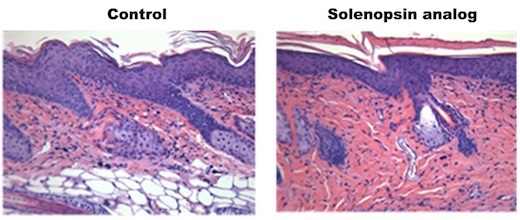
The treated mice displayed decreases in skin thickness and fewer immune cells infiltrating the skin compared the untreated mice. When applied to immune cells in culture, the compounds decreased the cells' production of the inflammatory signal IL-22 and increased production of anti-inflammatory IL-12.
The scientists also looked at how patterns of gene activity were changed in the skins of the mice after treatment. The solenopsin analog application turned down genes that are turned up by current treatments such as steroids and ultraviolet light.
"This may be compensatory and a mechanism of resistance to anti-psoriasis therapy, and it suggests that the solenopsin compounds could be used in combination with existing approaches," Arbiser says.
Image: Skin sections from mouse psoriasis model, after treatment with solenopsin analog or control cream. Image courtesy of Arbiser et al Scientific Reports.