 Researchers from University of Toronto's Institute of Biomaterials & Biomedical Engineering (IBBME) have transplanted healthy pancreatic cells under the skin to produce insulin for blood glucose regulation. This method could be used to treat type 1 diabetes.
There are a number of issues with other transplant sites like getting the cells to the right places or being damaged. Michael Sefton, a senior researcher of the study published today in PNAS and a professor in the Department of Chemical Engineering & Applied Chemistry and IBBME, notes that the skin has a great advantage as it is readily accessible, presents fewer hazards compared to other transplantation sites, and requires less transplantable donor cells.
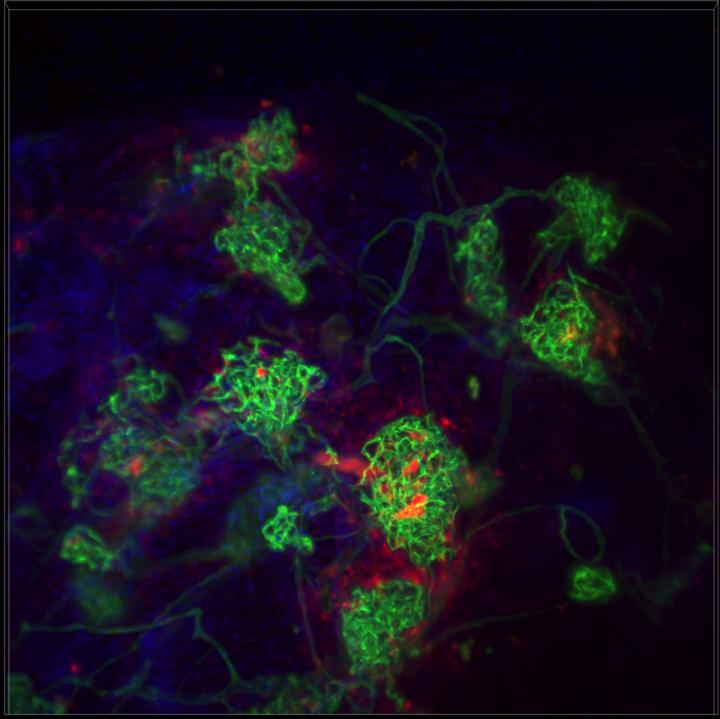
By performing the transplant at the skin, Alexander Vlahos, the lead author of this study and a PhD candidate at IBBME, was able to restore blood sugar levels within 21 days, if he created blood vessels at the same time. When the islet transplants were removed, glucose levels returned to diabetic levels.
"The next phase of our research will involve engineering the blood vessel network first and then injecting fewer islets into the already vascularized tissue," said Sefton. "A well-vascularized environment will allow more of the cells to survive and function within the host, reducing the need for multiple donors per patient."
Image: 3-D microscopy image showing pancreatic islets transplanted under the skin with a network support of blood vessels (green). Vlahos and his team were able to use this method to restore normal blood sugar levels within 21 days. Image Courtesy of the Sefton Lab.