Picking the right clone is of great importance in cell line development. In theory, the protocol is straightforward. But how you assess the presence of transgenes in the cells can result in uncertainty of zygosity or copy number variation.
Digital PCR systems Search Now Search our directory to the right digital PCR system for your research needs.
In eukaryotic cell lines, like CHO and HEK293, building a confirmed clonal population can take days or weeks. When a transgene integrates into the genome, it does so randomly, at unpredictable locations, in unpredictable copy numbers. Two clones that received the same construct can behave completely differently if one integrated in a silenced region and the other in a transcriptionally active region.
Conventional screening methods give you partial answers at best. Droplet Digital PCR (ddPCR), a technique developed by Bio-Rad, gives you absolute numbers, determining the exact quantity of target DNA molecules in your sample, which reduces guesswork. It works perfectly for 96- and 384-well plates, and target amplicons of up to 1,000 bases can be analyzed.
Quick Summary
- ddPCR provides absolute transgene copy number per cell without a standard curve, resolving differences that qPCR's comparative quantification cannot reliably detect.
- Beyond copy number, ddPCR can infer allelic balance at a locus, identifying clones with edits on one allele and those with edits on both.
- In practice, ddPCR functions as the front-end screen across full 96- or 384-well plates; the small number of top candidates then proceed to integration site mapping by inverse PCR or nanopore long-read sequencing.
qPCR, PCR, Southern blot, and their issues for clone selection
The classic methods for clone screening are qPCR, PCR, and Southern blot. All work, but have issues that often lead to repeated experiments, multiple biological replicates needed, and wasted time and resources.
qPCR relies on relative quantification, as it compares a sample against a standard curve or reference gene, which means amplification efficiency determines your result. A 10% reduction in efficiency can shift calculated concentrations by twofold or more.1 For copy number determination, that margin is too wide. A study compared qPCR and ddPCR against an amplification-independent reference method for copy number. qPCR returned a regression slope of 0.89 while ddPCR returned 0.995. qPCR systematically undercounts copy numbers, unlike ddPCR.2
PCR followed by gel electrophoresis can also be used to determine if your transgene is present, but quantification is difficult and relies on band intensity.
Southern blot is very accurate, but it requires large amounts of high-quality DNA, is technically demanding, takes days to complete as many cells must be grown, and cannot be run at the throughput needed to screen hundreds of clones.
How ddPCR works and why it provides absolute quantification
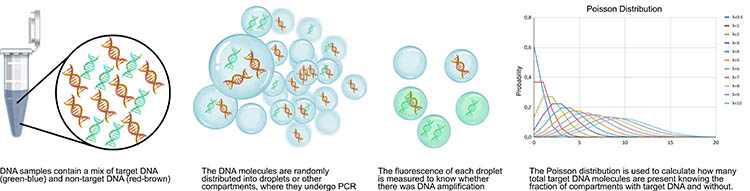
Figure 1. The basics of ddPCR. In it, DNA is distributed among partitions (droplets). After PCR amplification, droplets positive for fluorescence are counted. Using statistics, the total number of target DNA molecules can be quantified precisely.
ddPCR partitions a DNA sample into approximately 20,000 droplets. Each droplet runs an independent endpoint PCR reaction and is scored as positive or negative. The Poisson distribution converts the ratio of positive to negative droplets into an absolute copy count. This means no standard curve, so amplification efficiency does not change the result.3 Because of this, longer amplicons (up to 1,000 bases using probes) work well with ddPCR.4
For clone selection, ddPCR helps determine absolute copy number and the balance of edited versus wild-type alleles at a locus (which lets you infer mono- vs bi-allelic edits in many cases). While ddPCR cannot tell you how those copies are arranged along the chromosome or where in the genome they landed, complementary techniques can be used after ddPCR to answer those questions.
When does copy number matter?
When doing standard recombination work in bacteria, clone selection is relatively fast. Colonies grow overnight, and plasmids are separate from the genome. Colony PCR and Sanger sequencing are sufficient for confirmation.
Eukaryotic cell lines are a different story. In CHO cells (the main workhorse of biopharmaceutical manufacturing) transgenes integrate randomly into the genome at variable copy numbers. Two clones from the same transfection can have one, three, or seven copies of the gene. Both will test positive by PCR. Only copy number quantification tells you how many copies each clone has. And copy number matters: it correlates with expression level, but not linearly, and not predictably without knowing the integration site.
ddPCR can be used for precise, reproducible absolute quantification of genomically integrated transgene copies across the full cell line development workflow. Thanks to ddPCR multiplexing capabilities, multiple genes or target regions of the inserted DNA can be screened in a single reaction, which is helpful for bispecific antibodies and other complex constructs.5
ddPCR is also useful for synthetic biology workflows, copy number analysis in plasmids, and genomic insertions in bacteria.6
Zygosity screening in gene-edited cell lines
In CRISPR-edited lines like iPSCs or any cell line where both alleles matter, ddPCR also shines. A mono-allelic edit produces heterozygotes that will complicate any phenotypic readout. You need to know if the edit occurred in one allele or both.
ddPCR distinguishes a 1-copy result from a 2-copy result with the precision needed to know zygosity reliably.2 In fact, ddPCR can resolve copy number differences as small as 1.2–fold.7
ddPCR as part of a screening funnel
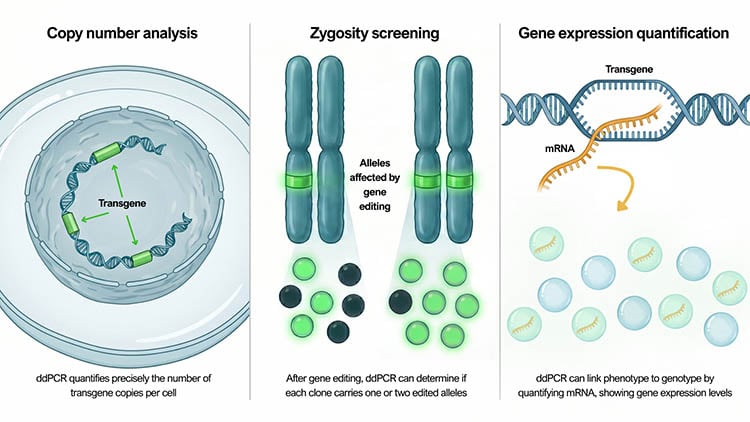
Figure 2. Uses of ddPCR for clone selection in eukaryotic cells
The practical workflow for eukaryotic clone selection is a funnel. ddPCR handles the screening of hundreds of clones across 96- or 384-well plates to determine copy number and zygosity. A small number of top candidates then go to integration site analysis.
Integration site matters because two clones with identical copy numbers can still have very different expression levels if one transgene landed near a silencer region, a heterochromatin domain, or a tumor suppressor locus. ddPCR tells you the quantity of gene copies per cell, but not exactly where those copies are in the chromosomes.
For integration site mapping, two workflows are validated. The first combines ddPCR with inverse PCR (iPCR): ddPCR confirms copy number and transgene integrity, then iPCR amplifies the unknown genomic sequences flanking the insertion.7 This works best when there is a low copy number of transgenes.
The second uses nanopore long-read sequencing8, which simultaneously estimates copy number, detects inversions, and maps the exact chromosomal location. ddPCR before sequencing results in a lower number of samples for NGS, reducing overall cost.
Gene expression screening with ddPCR
RT-ddPCR on mRNA quantifies absolute transcript copies per cell, with no standard curve, or amplification efficiency assumptions needed.
This helps you know whether high-copy clones are actually expressing more, or whether chromatin context, promoter methylation, or silencing is decoupling integration from output.
Matching absolute expression data to copy number and integration context gives you a much clearer picture of why two clones behave differently, linking genotype to phenotype, and helps answer the question of which clone is worth scaling.5
Frequently asked questions
Why use ddPCR instead of qPCR for clone selection?
ddPCR provides absolute copy numbers without the need of standard curves, both for DNA and mRNA targets, allowing faster identification of clones that have the ideal phenotype and expression levels without requiring comparative quantitation like qPCR does.
What specific advantages does ddPCR offer over other clone screening methods?
It provides absolute copy number per cell, with low input DNA, allelic balance analysis (zygosity), and allows 96- or 384-well plate runs. Because of all of this, it outperforms Southern blot, PCR, and qPCR for clone selection.
Can ddPCR be used to confirm CRISPR knockout efficiency across a cell population before single-cell cloning?
Yes. Before committing to the resource-heavy process of single-cell cloning and expansion, ddPCR can be run on a pooled, edited population to estimate the bulk editing efficiency—the ratio of edited to wild-type alleles at the target locus. If the pool shows low editing frequency, the cloning step can be delayed or the editing conditions optimized first. This saves weeks of work on populations that would yield few correctly edited clones.
References
1. Ruiz-Villalba A, Ruijter JM, et al. Use and misuse of Cq in qPCR data analysis and reporting. Life. 2021;11(6):496. https://doi.org/10.3390/life11060496
2. Zhang S, Rajadhyaksha EA, et al. Digital droplet PCR is an accurate and precise method to measure DNA copy number. Scientific Reports. 2025;15:36958. https://doi.org/10.1038/s41598-025-20944-4
3. Hindson BJ, Ness KD, et al. High-throughput droplet digital PCR system for absolute quantitation of DNA copy number. Analytical Chemistry. 2011;83(22):8604–8610. https://doi.org/10.1021/ac202028g
4. Krumbholz M, Goerlitz K, et al. Large amplicon droplet digital PCR for DNA-based monitoring of pediatric chronic myeloid leukaemia. Journal of Cellular and Molecular Medicine. 2019;23(8):4955–4961. https://doi.org/10.1111/jcmm.14321
5. Heinzelmann D, Lindner B, et al. Droplet digital PCR: a comprehensive tool for genetic analysis and prediction of bispecific antibody assembly during cell line development. New Biotechnology. 2023;78:42–51. https://doi.org/10.1016/j.nbt.2023.10.001
6. Plotka M, Wozniak M, et al. Quantification of plasmid copy number with single colour droplet digital PCR. PLOS ONE. 2017;12(1):e0169846. https://doi.org/10.1371/journal.pone.0169846
7. Nakagaki A, Urakawa A, et al. Application of droplet digital PCR in the analysis of genome integration and organization of the transgene in BAC transgenic mice. Scientific Reports. 2018;8:6638. https://doi.org/10.1038/s41598-018-25001-x
8. Nicholls PK, Bellott DW, et al. Locating and characterizing a transgene integration site by nanopore sequencing. G3 (Bethesda). 2019;9(5):1481–1486. https://doi.org/10.1534/g3.119.300582