While traditional methods are still widely used for generating research antibodies, newer approaches are becoming more common. This article explores some of the available options, including single B cell screening technologies, phage display, and the use of hyperimmune mouse technology.
Traditional antibody generation methods
For decades, research antibodies have been generated in two main ways: traditional polyclonal production in rabbits and larger mammals, and mouse and rat hybridoma development. Both involve immunizing animals with a target antigen and monitoring serum antibody titers. However, once the desired titer is reached, polyclonal antibodies are purified directly from the serum, while hybridomas are produced by extracting the spleen and fusing the B cells it contains with immortal myeloma cells. Following this, single-cell cloning is performed (usually by limiting dilution) to ensure that the antibody-producing cells are truly monoclonal and that antibody secretion can be stably maintained.
Search Antibodies Search Now Use our Antibody Search Tool to find the right antibody for your research. Filter
by Type, Application, Reactivity, Host, Clonality, Conjugate/Tag, and Isotype.
“During the cloning step, the hybridomas require a nutrient-rich media to ensure their survival,” explains Arazo Saadat, Manager, Monoclonal Antibody Development at MilliporeSigma, the Life Science business of Merck KGaA, Darmstadt, Germany. “In the past, researchers would include processed naïve mouse spleens in their media as a feeder layer or use media heavily enriched with serum to safeguard cell viability. Today, products such as MilliporeSigma’s BM Condimed H1 Hybridoma Cloning Supplement are often preferred at this stage since they eliminate the need for feeder layers or animal serums.”
Single B cell screening technologies
Single B cell screening technologies accelerate monoclonal antibody discovery by circumventing the arduous process of generating and testing hybridomas. According to Wei Ren, Chief Antibody Scientist at Sino Biological, the general methodology involves B cell isolation, followed by cell lysis, and sequencing of antibody heavy chain and light chain variable-region genes. These are then cloned into a mammalian cell line to enable screening of single B cell antibodies.
“Fluorescence-activated cell sorting (FACS) and the Beacon® Optofluidic System are two major techniques available to isolate antigen-specific B cells in the industry,” says Ren. “Notably, Beacon can automatically screen tens of thousands of plasma cells in just one day, significantly shortening the B cell screening process. At Sino Biological, the process of obtaining positive clones through Beacon is streamlined to just 35 days, from immunization to functional validation.”
- Single B cell screening using fluorescence-activated cell sorting (FACS)
An established approach to single B cell screening for antibody discovery relies on FACS to isolate antigen-specific B cells from the peripheral blood of immunized hosts. Importantly, using peripheral blood allows for resampling animals and producing polyclonal antibodies in parallel. “At Fortis Life Sciences®, we use this method to develop recombinant rabbit monoclonal antibodies,” reports David Potter, Sr., Director of New Product R&D, adding that rabbits generally yield antibodies with higher specificity and affinity for a wider array of epitopes than mice and are preferred for developing antibodies specific for mouse proteins.
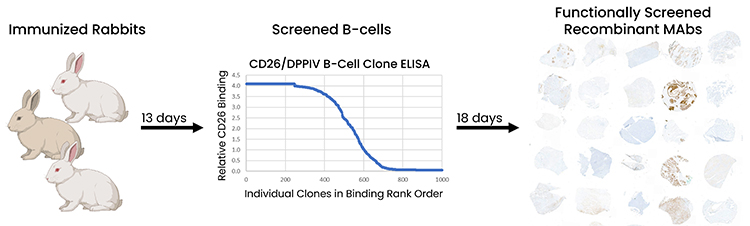
Immunized rabbits to functionally screened recombinant mAbs in 31 days at Fortis Life Sciences. Antigen-specific B-cells are isolated from rabbits and secreted mAbs screened by ELISA in 13 days. Candidate mAbs are then cloned, sequenced, and expressed for functional testing by IHC, WB, flow cytometry, and/or neutralizing assay in as little as 18 days.
“Our workflow involves expanding the sorted B cells and inducing them to secrete antibody, such that early binding and functional screening can guide the selection of optimal cultures,” says Potter. “These are then progressed to high-throughput cloning and recombinant mAb expression. Critically, once cloned, the sequence of the antibody is known, its monoclonality is assured, and it can be manufactured in vitro reproducibly and in a scalable manner. This contrasts with mouse hybridomas, which often express additional antibody chains, can exhibit variable growth and antibody secretion, can be physically lost, and do not inherently yield the sequence information needed to assure the identity and perpetual supply of the clone.”
- Single B cell screening with the Beacon Optofluidic System
The Bruker Cellular Analysis Beacon Optofluidic System combines Opto Electrical Positioning (OEP) technology with nanofluidics to enable rapid, high-throughput single B cell screening. Proprietary OptoSelect® chips, featuring thousands of NanoPen® chambers, replace conventional well plates, allowing for the isolation, culture, and analysis of individual B cells. Using a broad portfolio of function-first assays, the system facilitates deep characterization of antibody-producing cells and supports downstream sequencing applications.
“By enabling researchers to obtain comprehensive functional data for every discovered antibody sequence at high throughput and unprecedented speed, the Beacon Optofluidic System redefines the selection process for high-quality antibodies,” says Vikram Devgan, Ph.D., MBA, VP, Global Marketing at Bruker Cellular Analysis. “Additionally, Bruker Cellular Analysis provides modular chips, reagents, and protocols tailored to diverse project needs, whether for unique immunization strategies, various host species, or specific antigen targets.”
Phage display
Phage display is an approach used by Fortis Life Sciences to create immune-derived libraries from llamas and alpacas as part of a discovery pipeline for single-domain variable chain regions, known as VHHs. “These 14 kDa variable chains are monomeric, soluble, and matured by the animal’s immune system to produce tight and specific binding interactions,” reports Sam Sugerman, Ph.D., Principal Scientist, VHH Discovery. “Our workflow allows for isolating VHHs with many binding profiles, including human/cyno/mouse cross-reactive molecules, pH- and temperature-reversible interactions, and selectivity for isotype-specific interactions in high-homology families.”
Fortis’ discovery process encompasses animal immunization, monitoring of immune response, and isolation of peripheral immune cells to capture the matured single-chain antibodies. The single-domain fragments are then expressed on the surface of filamentous bacteriophage to produce a library of several million VHHs, which are enriched over multiple rounds of panning (sequential binding, washing, and propagation). “Individual clones are screened from the enriched pool as free VHH domains to identify clonal binders, which are sequenced and characterized,” says Sugerman. “Varying panning conditions, such as pH or protein identity, allows for more complex tuning of binding profiles.”
Hyperimmune mice
A main limitation of most in vivo antibody discovery platforms is the diversity of the host animal's immune response. One way of addressing this is to use a hyperimmune mouse model for antibody generation, such as the DiversimAb™ mouse platform from Twist Bioscience. “In hyperimmune mice, the immune system is turned up, increasing the epitopic diversity of the generated antibodies,” explains Emily Leproust, Twist Bioscience’s CEO and Co-founder. “Our proprietary DiversimAb mice can generate antibodies against difficult targets, including GPCRs, ion channels, and poor immunogens, and have even delivered antibodies against 100% Mus musculus proteins.”
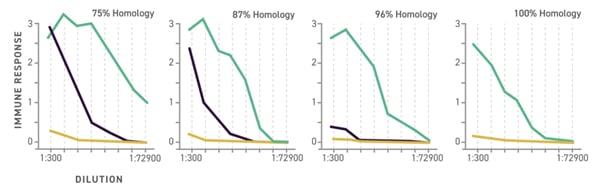
Comparison of antibody titers from DiversimAb™ and Balb/c mice across different antigen homologies. At each level of homology, the cohort of DiversimAb mice (green) had the most potent antibody response, followed by the Balb/c mice (purple) with a moderate response, and the pre-immune DiversimAb group (gold) with minimal response. Data provided by Twist Bioscience.
By combining its DiversimAb mouse platform with Beacon-based high-resolution B cell screening, Twist Bioscience has opened up opportunities to identify rare antibodies in previously impossible timelines. Ultimately, by leveraging the growing array of antibody generation advancements, the scientific research community stands to benefit from more efficient, tailored antibody discovery campaigns that can unlock new potential across a wide range of therapeutic and diagnostic applications.