Working with any infectious agent requires special procedures in a lab. With so much research going on with SARS-CoV-2, the virus that causes COVID-19, many scientists might benefit from a refresher in proper safety procedures. Techniques for using personal protection equipment (PPE), biosafety cabinets (BSCs), and more should be reviewed. Here, we explore the suggestions from several experts.
In Research Triangle Park, Advarra’s director of biosafety services Daniel Eisenman received so many calls about safety procedures that he wrote an article about it. Plus, the U.S. Centers for Disease Control and Prevention (CDC) prepared an overview on general lab safety in working with SARS-CoV-2.
Despite the terrible public health consequences of COVID-19, safety experts know how to work with this virus. “For the most part, it’s business as usual whenever working with an infectious agent,” says Kara Held, Ph.D., science director at The Baker Company. “There are certain protocols that need to be followed with every infectious agent that you’re working with, and SARS would be no different in that case.” She adds, “Make sure you follow those protocols very closely, and go slowly and carefully—do things very deliberately.”
Procedures with PPE
Culturing SARS-CoV-2 requires biosafety level (BSL)-3 containment, but working with clinical specimens from COVID-19 patients can be performed at BSL-2 assuming the appropriate safety practices are in place.
Those safety practices include using a BSC. “You need your basic parameters—wearing proper PPE or the work is conducted in a biosafety cabinet and that you have proper disinfection agents to be able to deal with it,” Held says. “However, when you have something such as a human infection, usually you want to make sure your PPE is stepped up from standard work.” That means not just a lab coat and gloves, but scientists may want to have some sort of respiratory PPE, as well.
For top-notch guidance on putting on and removing PPE, the CDC provides several resources. For the overall procedure, starting with a gown, followed by a mask or respirator, then goggles or a face shield and finally gloves, review the CDC’s sequence.
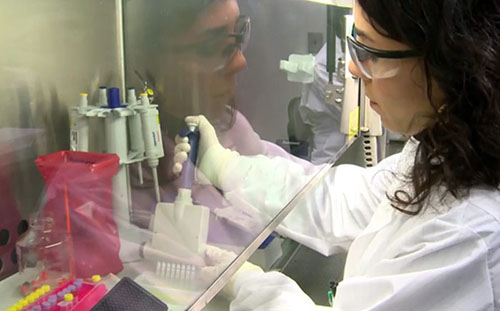
Image:Biosafety cabinets are not magic boxes. You have to work properly in them. Image courtesy of Baker
For more specific steps, the CDC produced documents for particular items, such as How to Wear Masks. In research labs working with SARS-CoV-2, just any mask is not enough. “On the PPE side, make certain that there is an N-95 or greater protective device that’s available,” says Dan Glucksman, director of public affairs at the International Safety Equipment Association (ISEA). “Any kind of sample could become aerosolized.”
How personnel protect their hands also matters. “With lab safety, some of the key things are going to be gloves,” Glucksman explains. “Most labs are using a nitrile-based glove, because those have a little bit more flexibility and give.” He adds, “Vinyl gloves are less expensive, but they don’t have the same elasticity of nitrile or latex gloves.” With SARS-CoV-2 or other infectious agents, lab managers should put safety over price whenever possible.
Assessing a situation
Eisenman and his colleagues serve a range of clients, many of them involving clinical and preclinical projects. When helping a client work safely with an infectious agent, Eisenman begins with a risk assessment. Here, he asks: What are the risks? How could someone potentially be exposed to an infectious agent. This process also involves considering the risks associated with procedures that need to be performed.
Once a risk assessment is complete, Eisenman says, “then proactively create a risk-mitigation plan.” He adds, “Create a safe environment proactively, instead of being reactive.” For academic labs, a biosafety office can help with these steps. For a biotechnology company, Advarra can provide these services. Advarra also works with pharmaceutical companies and contract research organizations. During the COVID-19 pandemic, some labs are just starting research on this infectious agent. In those cases, looking for professional safety guidance could be even more important.
Eisenman’s team performs remote or in person facility walk-throughs. He says, “This information allows us to envision the workflow, perform a comprehensive risk assessment, and help develop a risk-mitigation plan specific to the client’s needs.” In some cases, such projects even reveal that a lab lacks the necessary equipment, such as a biosafety cabinet.
Assessing the equipment
To learn more about biosafety cabinets, we again turned to Held. With SARS-CoV-2, she says, “Working in a biosafety cabinet is actually really great for that, because it does help control any aerosols that might be generated, which could be a potential source for infection for the worker.”
A BSC alone, though, is not necessarily all that a scientist needs to work with SARS-CoV-2. “Depending on the protocols being done, you may need a respirator and a biosafety cabinet,” Held explains.
Plus, it’s not just the equipment. “Biosafety cabinets are not magic boxes,” Held says. “You have to work properly in them, make sure that you use slow movements when entering or exiting the cabinet, and don’t block any of the air vents that are there.”
All BSCs must meet the same requirements. In the United States, a BSC can be certified to the NSF International Standard 49 (NSF/ANSI 49-2019). “This is an independent group that all of the manufacturers of the biosafety cabinets are part of,” Held explains. “There are very specific criteria of how the cabinets are built and tested and how much protection they must provide to be considered an NSF-accredited biosafety cabinet.” Plus, a BSC must also perform as intended, and that depends on annual certification by a certified expert.
Working with liquid-based infectious agents poses special challenges. “Really the biggest caution is with anything that can create small droplets of water or solution that could contain viral particles,” Held says. “You want to try and minimize and contain all of those as much as possible.”
With the right safety equipment and procedures, scientists can minimize the risk of working with SARS-CoV-2.
Hero image: Scanning electron microscope image shows SARS-CoV-2 (yellow) emerging from a surface of cells (pink). Image from NIAID