With ever-increasing demand for greater efficiency, scientific organizations are turning to data-intelligence systems to provide visibility into lab operations and help drive decisions.
The importance laboratory leaders place on increasing speed, optimization, and efficiency was recently highlighted in a Pharmaceutical Laboratory Leaders Survey:
- Speed was the #1 concern of pharmaceutical laboratory leaders as the requirement for higher sample throughout continues to increase dramatically
- Furthermore, 83% believe their workflows need optimization and 63% would welcome new innovations to increase efficiency
Increasing laboratory efficiency can be broken down into two broad categories: sample analysis throughput and laboratory operations. Here, we will explore current and future solutions surrounding operational efficiency and the fundamental shift toward a new data-intelligence paradigm.
Advanced laboratory monitoring
As laboratory complexity continues to grow throughout science organizations, the need for comprehensive visualization of all laboratory assets has become of paramount importance. Advanced lab-wide monitoring and management capabilities fill this need by bringing clarity and control to laboratory operations.
Questions commonly asked by laboratory leaders include:
- What laboratory assets do I have?
- Why do I have those specific assets?
- How are those assets being used?
Asset utilization programs can answer these questions by providing insight into inventory control, fleet right-sizing, and many other aspects needed to advance laboratory operations.
Lab visualization dashboards display which laboratory assets are being used with profound clarity. An instrumentation heat map provides a snapshot of the entire fleet based on usage. This comprehensive view of instrument utilization forms the basis for data-driven decisions. Furthermore, such programs can identify workflow bottlenecks, capacity issues, and other inefficiencies.
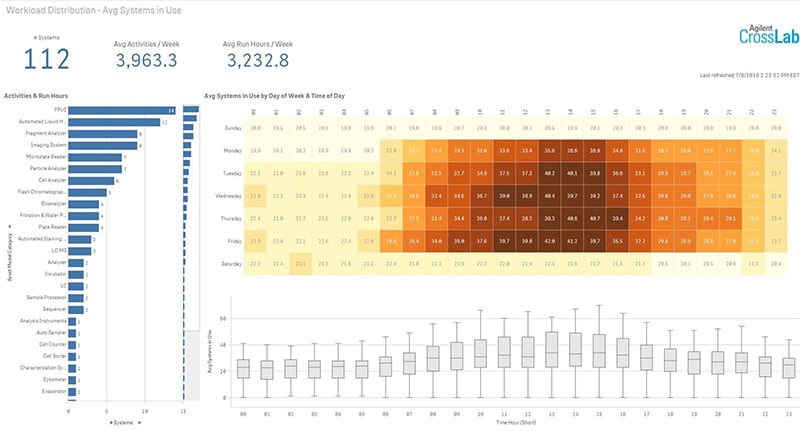
The information is relatively easy to access and use. By applying appropriate filters to an area of interest, such as a specific lab site or group of instruments, and setting the desired timeframe, the visualization program can determine precise frequency and usage patterns. This process provides line-of-sight down to the level of individual instruments as well as a lab-wide view of all instrumentation in concert.
By ‘turning on the lights’ in this manner, utilization programs provide an excellent view into what is actually happening in the lab. Users immediately see bottlenecks and other inefficiencies that have been uncovered and can now do something about them.
To do this properly, there remains the need to integrate and interpret the utilization data, which requires further analysis and expertise to begin the process of improving lab operations. The ability to change is a key factor.
Change management expertise
In today’s fast-paced world, change management can become a burden. Laboratories need to be able to adapt rapidly to changing business conditions. Those that don’t can potentially fall behind in the competitive game of efficiency. To prevent this, it is imperative that change management includes a combination of data intelligence for clarity and expert guidance for change.
Industry expertise can shed light on how best to right-size and ‘balance’ an instrument fleet, making it nimble and able to address new demands from increasingly complex and competitive environments.
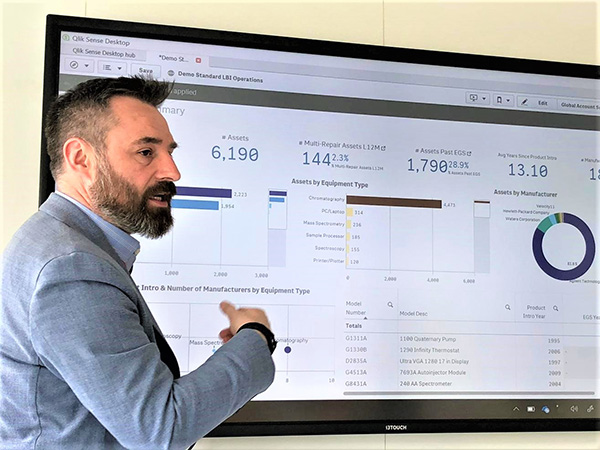
CrossLab Enterprise expert Greg Stevens presents an instrument health evalution to assess an entire instrument fleet.
Data visibility is a powerful strategic tool that requires expert guidance to break away from industry peers with increased efficiency, adaptability, and profitability.
Advancing lab operations can be viewed as three distinct phases: simplification, optimization, and transformation. To begin the process, simplification requires an assessment of all laboratory assets to know where things stand. As we have seen, data-intelligence tools help to visualize the entire fleet and allow better control over assets. Optimization combines utilization data with other instrument attributes, such as service history, age of equipment, and end-of-service terms. A risk score can be developed to measure the ‘health’ and viability of each instrument.
A visualization of instrument service histories and end-of-guaranteed support provide the basis to perform statistical analysis and determine which assets may be prone to breakdown and may need replacement. This pragmatic view of instrument health greatly simplifies deciding which assets to retain, redeploy, or potentially sell—the proceeds of which can be put toward ‘tech refresh’ with new instrumentation.

At this point, experts can help illuminate opportunities and prioritize where to focus efforts for improvement to match overall business goals. Data intelligence and expert guidance provide a strong foundation to answer such functional questions. As more data utilization and analysis is acquired and digested over time, tailored adjustments can be made to further increase efficiency. More importantly, data-driven decisions provide a high-level of confidence that lab operations are optimizing the availability and use of all equipment.
Finally, transformation of all lab operations to a lab-wide, data-intelligence management system ensures that all instrument utilization and expenditures achieve maximum efficiency. Data-driven decisions are becoming the standard for best-in-class laboratories and organizations.
Final thoughts
As the complexity and interconnectivity of scientific systems continues to rapidly change the laboratory environment, there is an ever-increasing demand for higher efficiency with diminishing bandwidth to achieve it—this often results in too much time being spent on operational issues rather than science. Advanced data-intelligence systems in concert with expert guidance are quickly becoming the mainstay for all laboratory operations. The demand for operational excellence is growing rapidly, even to the level machine learning, where artificial intelligence is currently being explored to expand lab-wide visibility and efficiency with unprecedented refinement.
Philippe Desjardins is a lab productivity scientist at Agilent Technologies.