As it gets less expensive and easier to use next-generation sequencing (NGS), more scientists will apply it. Still, the results need to be accurate. In fact, the spreading use of NGS—for example, as it’s used more frequently in clinical settings—could fuel the requirements for even better data. The results of this sequencing depend on working with a reliable library, which consists of the nucleic-acid fragments that will be sequenced. The experts interviewed here discuss the reasons to get a robust library and how to do it.
Before even getting an NGS library, the nucleic acids samples must be examined. In the “Importance of QC in NGS Library Preparation”—a webinar produced by Biocompare, EMBL, and Advanced Analytical (a part of Agilent)—Ferris Jung, a research technician at the Genomics Core Facility at EMBL, said, “We really need to know what we are working with in order to be able to prepare good libraries and good sequencing results.” So, step one is performing quality control on the original sample, but that’s just the start.
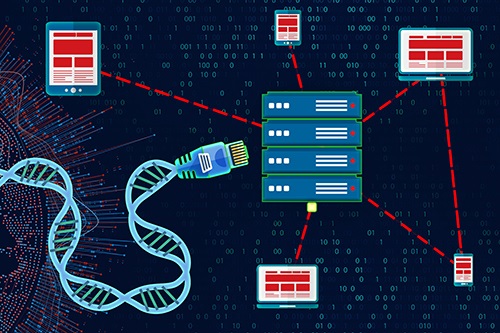
Image: Getting the best results from next-generation sequencing depends on starting with a high-quality nucleic-acid sample and using that to build a robust library. Image from National Human Genome Research Institute.
Cell-free options
Instead of obtaining DNA from cells, some samples contain cell-free DNA (cfDNA). Chris Troll, director of assay R&D at Claret Bioscience, and his colleagues point out that, although still in its infancy, cfDNA can be used in various clinical applications including tracking the progression of cancer. In their work, Troll and his colleagues describe the Single Reaction Single-Stranded Library (SRSLY) preparation method.
Here, we’ll consider some differences between single- and double-stranded DNA (ssDNA and dsDNA, respectively). “The idea behind SRSLY—and all ssDNA NGS preps—is that they capture a more diverse set of molecule types than dsDNA and tagmentation-based preps,” Trolls says. “Since NGS adapter ligation occurs after an initial denaturation, ssDNA preps can convert ssDNA and both strands of nicked dsDNA into sequencible molecules, in addition to undamaged dsDNA molecules, whereas dsDNA and tagmentation methods cannot.” He adds, “SRSLY and other ssDNA preps also tend to capture shorter fragments than other prep methods.” That can be especially useful when working with degraded or damaged samples.
As Troll notes, ssDNA-based NGS library prep methods tend to take more time and often have many more protocol steps than NGS methods that leave dsDNA in duplex form through adapter ligation. “This tends to make researchers shy away from [ssDNA-based methods] even though they might be a better method for the samples they are working with,” Troll explains. Claret Bioscience’s SRSLY preparation method, he says, “shines in its simplicity.” He adds, “The SRSLY kit is even easier than what is written in the manuscript’s methods, and the number of protocol steps and time to generate a complete and complex library with SRSLY is less than the vast majority of dsDNA and ssDNA kits on the market.”
Lighting up new libraries
The method of making a library can impact the outcome in many ways. Scientists are testing various adjustments to the process. At the Lawrence Berkeley National Lab, for example, computational staff scientist Nathan Hillson and his colleagues tried improving library preparation by adding fluorescent amplification.
In this work, Hillson and his colleagues added real-time quantitative PCR to the typical NGS-library preparation. According to Hillson, the main interest was to “increase our operational capacity and efficiencies.”
The results, he says, reduced the per sample resource requirements, including labor and reagent costs. This method, fluorescent amplification for NGS (FA-NGS), also increased the lab’s sample rate per week and improved the quality of the sequencing results, Hillson says.
Less making more
The kind of sample preparation needed for sequencing also depends on the sequencer that will be used. At Johns Hopkins University, Michael Schatz, Bloomberg Distinguished Associate Professor of Computer Science and Biology, and his team use a MinION sequencing platform from U.K.-based Oxford Nanopore Technologies. In the sequencer line from Oxford Nanopore, the MinION is the most affordable.
A key to the work from Schatz’s lab is to sequence longer segments of DNA. “With increased read lengths, you can detect certain mutations that are invisible with short library preparations” he says. “Longer molecules span novel insertions, for example.”
Despite the benefits of the MinION, it’s not powerful enough to easily get useful information over an entire genome. “To do genome-wide sequencing with a MinION, you need to do many runs,” Schatz says. “That increases cost, decreases how fast you can go through samples, and limits what you can do, especially with patient data.”
Schatz and his team wanted to work with long reads but focus the sequencing on specific regions. The scientists accomplished that with Read Until sequencing. With this technique, Read Until ejects molecules that are of no interest in the investigation. “It’s amazing that you’ve got that much control—to pick and choose at the molecular level,” Schatz says.
As explained by Sam Kovaka, first author on the paper and a doctoral student in Schatz’s lab, “This involves pretty standard Nanopore library preparation—no special capture or designing PCR primers, and no special reagents.” It only takes an afternoon or less to prepare a library for Read Until sequencing.
Still, working with longer pieces of DNA creates some challenges. “You even need to be more careful with things like the diameter of a pipette,” Schatz says. “You need to avoid electrostatic forces that can prevent you from getting an entire chromosome or at least big, intact pieces, but those techniques are well-established.”
The most exciting thing comes from the information that Schatz and Kovaka collected. “The number of variants that you get from a single run is amazing, such as getting epigenetic modifications along with other variants,” Kovaka says. With other platforms, it takes a separate run to analyze epigenetic events, such as methylation.
Seeing so many variants from a single sequencing run promises many uses in the clinic. “This platform can examine all of the variants, and that could be a good thing for patient care,” Schatz says. That said, it’s going to take some time to get this method into healthcare. “We’re seeing things that have never been seen,” Schatz says. “So, we need time to determine the risk factors for patient mutations.”
NGS is all about putting the best samples into a sequencer. As Jung reminded us at the beginning of this article, scientists need the right nucleic-acid samples to build the right library and obtain accurate results from sequencing. Some of the techniques described here, though, make library preparation easier or more powerful—sometimes both.