Developing the world’s first ELISA was no mean feat. Not only did the researchers involved have to figure out how to immobilize an antigen to a solid surface, they also had to raise and purify antibodies, create their own antibody-enzyme conjugates, and determine a way to accurately quantify the antibody-antigen interaction. These days, running an ELISA is far more straightforward. With a vast range of ready-to-use kits available, researchers can generate ELISA data in just hours, often with fairly minimal effort. But despite workflows becoming simpler, it is always worth considering ways to improve ELISA performance.
Choose an ELISA that meets your needs
Although early ELISAs used an immobilized antigen directly bound to a surface, detecting this with a single antibody, the technique has since evolved to use antibodies as both capture and detector reagents. “Both direct ELISA and sandwich ELISA have a role to play,” notes James Murray, director, immunoassay development at Abcam. “Direct ELISA is very good for detecting and measuring the concentration of small molecules since it requires only a single antibody binding site, whereas sandwich ELISA is more suited to larger molecules such as proteins because it requires that two epitopes are accessible simultaneously. Whichever format is chosen, it is important to confirm the assay is sensitive enough to detect your target of interest, ideally at a baseline level in your control samples.”
“Even with many competing formats, sandwich ELISA is still considered the gold standard for quantitative measurement,” reports Mark Stump, associate director of molecular assays at Cell Signaling Technology. “Using two specific antibodies eliminates considerable noise, plus a sandwich configuration lends itself to easy wash steps that help remove the problem of nonspecific binding. These advantages far outweigh the fact that sandwich ELISA has more protocol steps than direct ELISA.”
Pay attention to standards and controls
Many commercially available ELISA kits include reference material for use as a standard or control. Although it is tempting to take this at face value, Stump highlights the importance of checking that it is consistent with the kit’s intended use. “By spiking the reference material into various matrices, developers of ELISA kits can confirm that these cause no adverse effects,” he says. “However, because not every model system can be tested, a researcher should check the provided standard in their own system to make sure it does not affect the control signal.”
“Using reference material that is calibrated with World Health Organization (WHO) standards allows researchers to compare ELISA kit performance between labs and across geographies,” explains Megan Larson, product manager at Bio-Techne. “As awareness of the reproducibility crisis continues to grow, the use of international standards is an effective approach to ensure lot-to-lot consistency. It also provides a way of comparing performance with other commercial kits that correlate to the same WHO standard.”
Follow the protocol
“ELISA kit manufacturers perform a great deal of optimization to provide researchers with a sensitive and reliable assay,” notes Richard Delle Bovi, Ph.D., product manager at Enzo Life Sciences. “This includes testing different antibodies, buffers, and incubation conditions, as well as monitoring product stability, reproducibility, cross-reactivity, and intra/inter-assay precision. The resulting information is summarized in the accompanying manual, alongside a detailed protocol designed to assure experimental success.”
“Following the protocol precisely is fundamental to the quality of ELISA data,” adds Murray. “Researchers should be consistent with the timing of the various assay steps, the order that materials are added across the plate, and the way that plates are washed and developed.” He also recommends using a multichannel pipettor for speed, pre-wetting the pipette tips, making sure to expel all material from them, and changing the tips frequently to avoid cross-contamination. “Material carryover can be a significant source of error within an ELISA,” he says. “It can be prevented by using disposable tips and by ensuring pipettors and automated instruments such as plate washers are routinely monitored to confirm they are performing as expected.”
Understand the antibodies
Whether you’re developing your own ELISA in-house or using a kit, assay performance hinges on the quality of the antibodies. “Researchers developing their own assay should recognize that antibodies verified in other applications may not be the optimal choice for an ELISA,” says Stump. “Moreover, to ensure accurate ELISA results, capture and detection antibodies need to be validated together, as a pair. At CST, we screen numerous antibody pairs in different combinations and orientations to find that which maintains the selectivity and specificity of the individual components; the antibodies are then carefully titrated to optimize the signal. Successful pairings form the basis of our PathScan® and FastScan™ ELISA kits, with the latter providing highly sensitive target detection in as little as 90 minutes—a vast improvement on many ELISA timelines.”
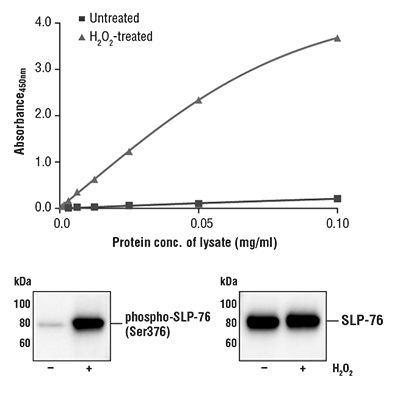
Image: ELISA detection of phospho-SLP-76 (Ser376) using a FastScan™ sandwich ELISA kit from Cell Signaling Technology. Treatment efficacy is supported by Western blot analysis.
Consider using automation
Automation is widely recognized for its capacity to improve assay reproducibility, removing many potential sources of variability to deliver more robust results. “A major advantage of our Ella™ automated ELISA platform is its transferability,” notes Larson. “Assays performed on the Ella in one lab are directly comparable to assays performed on the Ella in other labs, regardless of the user. The format mirrors a conventional sandwich ELISA, yet everything—including the calibration curve—is pre-loaded on to a cartridge. Researchers simply add sample and buffers to the cartridge, introduce this into the instrument, and walk away, thereby avoiding the pitfalls of pipetting errors, material carryover, or user-variation—all of which can impact on results when an ELISA is carried out manually.”
The role of manufacturers
Those developing and manufacturing ELISAs are well aware of the need to streamline workflows and, with novel targets continually being identified, there is an ongoing drive for them to generate new products that meet researchers’ needs. “ELISAs have consistently accounted for the largest share of the immunoassay techniques employed in research,” notes Delle Bovi, “and their use continues to grow year-on-year. Many researchers remain loyal to an application that has been around for decades and which they trust to provide quick and reliable results. Manufacturers respect this as they expand the scope of existing products and develop approaches to improve them.”
With consensus showing that ELISA is here to stay, it seems clear that researchers and manufacturers alike are keen to push the technology to new levels. It will be interesting to see if ELISA maintains its dominance of the immunoassay market in the years ahead.
A novel ELISA provides HCP detection
GE Healthcare’s host cell protein (HCP) ELISA is a prime example of a product that has been co-developed by experts in the research industry to meet an emerging requirement. Unlike a regular ELISA that targets an individual protein, the HCP ELISA is designed to detect the many thousands of proteins that are expressed by a host cell during the production of a biologic such as a therapeutic monoclonal antibody. Reducing HCP levels is essential to assure patient safety, meaning the HCP ELISA has utility throughout the entire drug development process. “The use of ELISA to measure HCP has grown as the number of biologics in development has increased,” explains Tim Fagge, general manager, imaging and western blotting at GE Healthcare Life Sciences. “Working in partnership with Rockland Immunochemicals, we’ve developed an antibody with broad coverage against target HCP populations. This forms the basis of our HCP ELISA, where it provides high sensitivity and a wide linear dynamic range.”