The overarching requirement of cell culture is to recreate the cellular micro-environment, bringing in vivo physiologic conditions to an in vitro setting that supports healthy cell growth and proliferation. With applicability from basic science through to clinical research, cell culture has advanced significantly in recent years to support a growing range of applications. These include greater use of primary cells, stem cells, organoid 3D cultures, and genetically engineered cell lines, driving tool providers to develop increasingly innovative products to support optimal cell growth.
“The implications of not optimizing cell culture thoroughly can be poor cell growth, low viability, morphological changes, and genotypic or phenotypic shift, which ultimately have a negative impact on experimental results and reproducibility,” explains Fang Tian, lead scientist at ATCC. “Among the most important factors to optimize are the basics,” adds Ann Rossi, Ph.D., applications lab manager at Corning Life Sciences. “These comprise the vessel that becomes the new physical home for the cells, the media that provides essential nutrients to regulate the cell cycle for sustained growth and proliferation, and attentive maintenance to propagate healthy cultures free of contamination.”
Cell type and application will influence optimization strategy
Rossi elaborates that optimization is typically cell type and application dependent. “If the goal is routine 2D culture of an immortalized cell line demonstrating high yield and high percent viability without regard to a specific morphology or phenotype other than cell health, optimization can be relatively straightforward,” she says.
“Immortalized cells have, through ease of use, historically been used for applications less sensitive to phenotype such as first-pass cell-based screening to narrow a large compound library. This data is collected with the caveat that the in vitro culture conditions do not fully represent in vivo physiology. As progress through the drug discovery cascade requires hit validation in more complex cell models designed to better predict therapeutic efficacy and toxicity, a different level of optimization may be necessary, but that level will depend on the desired application. For example, culture of human iPSCs for cell therapy would require defined xeno- and serum-free conditions necessitating the use of specialized media and reagents, while the in vitro stem cell environment must be tightly controlled to maintain pluripotency and only trigger differentiation as desired.”
Authenticated cell lines are essential
Stressing the importance of using authenticated cell lines from a reliable source, Tian highlights that it was once common practice for researchers to share cultures without confirming cellular identity. The problem of cell-line misidentification has been discussed at length including in a recent Biocompare documentary.
“Before providing cells for purchase we perform comprehensive authentication and characterization,” she says. “This includes tests for cell identity, cell purity, sterility, morphology, growth, viability, post-thaw recovery, individual cell line-related biomarkers, unique biofunction and molecular profiling. We then supply end users with detailed, cell line-specific recommendations to ensure optimal culture, such as an appropriate growth medium, subculture procedure and ratio, media change frequency, and cryopreservation medium.”
ECM plays an important role
Offering a suite of extracellular matrix (ECM) products for enhancing 2D and 3D cell culture, East River BioSolutions has demonstrated that culturing cells in their endogenous (i.e. native) cell-specific ECM results in superior cell performance in vitro.
“The cellular microenvironment is critical to successful cell culture but is often overlooked,” explains John O’Neill, CSO of East River Bio. “Commonly used substrates are synthetic, single biochemical components, or derived from a diseased murine source. As a result, in vitro culture remains limited, and these limitations underlie the lack of sufficiently predictive models in pharmaceutical drug development. East River Bio’s ECM substrates recreate native cell environments by providing the full milieu of ECM components (proteins, proteoglycans, glycoproteins, growth factors) in a specific tissue—a ‘cell-specific niche in a dish’. These ECM substrates support cell attachment, viability, and phenotypic maintenance, which facilitates optimization.”
East River Bio’s NativeCoat™ ECM Surface Coating products are suitable for 2D culture of any cell type, and their TissueSpec® ECM Hydrogels and Scaffolds are ideal for 3D cell culture, O’Neill reports. “Cells cultured with tissue-specific ECM behave more as they would in vivo,” he adds. “These optimized conditions present a new paradigm for accelerating drug development with more predictive in vitro models of human physiology. In the future we may be able to personalize ECM substrates, increasing physiological relevance even further.”
Optimized biotherapeutic production
Typically reliant on suspension cells, expression systems designed for biotherapeutic production require thorough optimization to maximize yield and product quality. “Selection of a fully optimized cell line for the final application is critical,” explains Philippe Funfrock, president and CEO at ProteoGenix. “Biotherapeutic production can be extremely costly, therefore a cell line offering superior production can significantly reduce outlays. To address this, we’ve set up a cell-line engineering platform that has already led to the creation of a new CHO cell line intended for better transient protein production (XtenCHO™ cells). This has out-performed competitors for the production of therapeutic antibodies such as Utomilumab and Pembrolizumab, with yields up to 800 mg /L.”
Adding that the adoption of a standardized approach to optimization is impractical since each expression system exhibits unique characteristics, Funfrock notes that certain key parameters are common to all expression systems. “We consider optimization of the gene, expression vector, and culture media via a systematic approach,” he says, “using this information to guide our customers along the different steps of the drug discovery process. Small adjustments in cell culture protocol can have a major impact on final yield, so a timely awareness of these factors is essential.”
Enhanced simulation of in vivo physiology
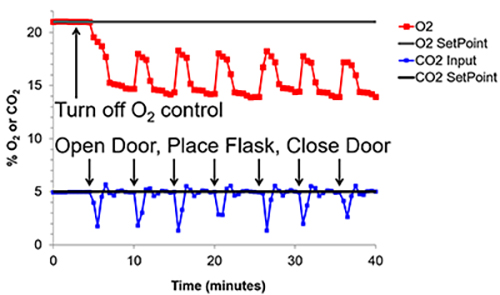
Introducing an innovative way of thinking about the cellular environment, BioSpherix is on a mission to improve data relevance through their Xvivo System, a modular technology designed to give unprecedented control over phenotype. “By providing uninterruptible regulation over a greater number of critical parameters, the Cytocentric Xvivo System simulates constant physiologic conditions to generate more consistent results,” explains Alicia Henn, CSO. “During traditional culture, cells are regularly exposed to sub-optimal conditions, for example as incubators are opened or passaging takes place in uncontrolled conditions. In contrast, Cytocentric Xvivo Systems are a modular arrangement of laminar flow hoods, buffer chambers, and chambers for incubation, processing, and instrumentation—which link together seamlessly to ensure a fully contained cellular environment.”
Image: Opening and closing the incubator door creates highly variable conditions, with CO2 charge-up following door closure driving O2 levels down. Contrastingly, Cytocentric Xvivo Systems provide uninterruptible regulation. Image courtesy of BioSpherix.
Designed to protect the entire cell-based process, Cytocentric Xvivo Systems provide an aseptic environment for cell and tissue handling. This can save time that might otherwise be spent in decontamination, restarting cultures, and repeating experiments. The modular nature also affords future-proofing. “Cells are dynamic, not static, and their needs change over time,” says Henn. “By providing full-time optimal conditions that closely mimic physiologic simulation, and with the option to program in oxygen changes such as a pre-implantation hypoxic shock, Cytocentric Xvivo Systems deliver total quality for better reproducibility.”
While cell culture optimization may once have been focused on choosing an appropriate media, identifying suitable concentrations for additives such as growth factors, and gauging the level of confluence at which to sub-culture the cells, researchers are aware that many additional elements have key roles to play in sustaining healthy cell growth and proliferation. With the use of more complex cell cultures continuing to rise, thorough optimization will remain pivotal to the generation of physiologically relevant data.