Western blotting was first described in 1979, when Renart et al. detected specific proteins in crude extracts by gel electrophoresis followed by transfer to diazobenzyloxymethyl paper and probing with antisera. Western blotting has since become one of the most widely used methods of identifying proteins in complex samples, yet while the process has evolved significantly since its inception it remains a major source of frustration to researchers due to the time-consuming and largely manual workflow.
Amy Emery, research associate at the University of Cambridge, has run hundreds of Western blots during her career within cancer research. “I regularly use Westerns to provide confirmation that an antibody recognizes its stated target, to produce visual evidence of the effects of a compound dose response, or to probe the results of an immunoprecipitation,” Emery explains. “But although Westerns usually generate a definitive outcome, the length of time and effort taken to reach that result can be a major bottleneck. Without taking into account sample-preparation time, a typical Western can require almost two days to yield meaningful data.”
According to Emery, aside from running the gel and performing the transfer, the most time-consuming steps are the antibody incubations. “I routinely perform my primary antibody incubation overnight to maximize signal, especially since I often study proteins of low abundance, but a knock-on effect of this is that by the time the results have been analyzed, it’s not always possible to set up a further Western that same day. This is particularly an issue during optimization, for example when identifying an appropriate antibody concentration for subsequent experiments, and on occasion it can take a week to establish ideal conditions before data can then be generated from test samples.”
Emery adds that the wash steps also take up valuable time, but acknowledges that with the introduction of powerful and sophisticated imaging systems there is no longer a necessity to spend extended periods in the dark room. “I have access to a LI-COR Odyssey for processing my Western blot data, and since this is situated in the main lab, I can concentrate on other tasks while my blot scans.
Developments
The team at Precision Biosystems is well aware of the time spent by researchers developing their Western blots, and to improve the efficiency of this process they created BlotCycler™, an automated system for Western blot development that provides complete automation of all blot processing steps. Russ Yukhananov, CEO, says that “once the researcher has set up BlotCycler with the necessary reagents and selected their protocol, they can walk away while the instrument performs all blocking, washing, and incubation steps.”
Not only does this free up considerable amounts of time, it also improves reproducibility by eliminating any slight variations in fluid delivery, timing, and washing that may occur when protocols are performed manually. “Manual processing can easily introduce bias,” says Yukhananov, “whereas a direct comparison of manual and automated processing has clearly demonstrated the superior reproducibility of BlotCycler. Automatic processing yielded consistently higher signal at room temperature and at 4°C, although the effect on signal intensity was more pronounced at 4°C.”
Biocompare’s Western Blot Search Tool
Find, compare and review Western blot
products from different suppliers Search
BlotCycler also minimizes the time devoted to optimizing antibody concentrations by allowing multiple membranes to be probed simultaneously, a benefit enjoyed by Amit Thakar, senior research scientist at the University of Wyoming. "To generate reliable immunoassay results, it is essential that an antibody is highly specific for its target," says Thakar. “Western blotting with the inclusion of appropriate controls is fundamental to the antibody validation process, however it can require the time-consuming and labor-intensive development of multiple blots. BlotCycler greatly simplifies this process. ”Yukhananov explains that “a further advantage of BlotCycler is that the primary antibody solution is collected after use. This is often the most expensive reagent 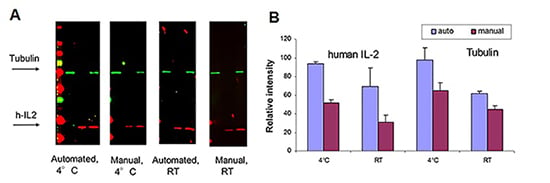 in the Western blotting process, and by facilitating its repeated use Precision Biosystems affords researchers substantial cost savings.”
Image: Automatic Western blot processing using BlotCycler demonstrated consistently higher signal than manual processing, according to Precision Biosystems.
Another company with a strong focus on improving the efficiency of Western blot development is MilliporeSigma, whose SNAP i.d.® 2.0 Protein Detection System shortens the time required for blocking, washing, and antibody incubations to 30 minutes. Karen Tiano, company spokeswoman, explains that this unique tool relies on a vacuum to actively drive reagents through the membrane.
“During conventional Western blotting, development can take from 4 to 24 hours since diffusion is the primary means of reagent transport,” says Tiano. “SNAP i.d. 2.0 accelerates this process, providing immunodetection with no loss of signal intensity in a fraction of the time required by more traditional methods.” Furthermore by providing users with the capability to process multiple blots simultaneously, SNAP i.d. 2.0 affords rapid optimization of immunodetection conditions. “Researchers often lack the time to fully optimize their blotting protocols,” adds Tiano. “With our comprehensive guidelines, converting from standard protocols or assessing new antibodies is simple.”
Jeff Harford, senior product marketing manager at LI-COR Biosciences, points out that Western blots have traditionally been over-simplified, producing a mindset that the same methods, antibody dilutions, and protocols may be used regardless of the target, antibody, or method of imaging. “This has been shown definitively not to be the case,” says Harford, “and for a researcher to have confidence in what they’re measuring, one essential consideration is for their imaging system to produce robust and replicable data.”
LI-COR offers three specialized imagers for analyzing Western blot data. The C-DiGit® Blot Scanner is a chemiluminescent imager, while the company’s flagship product, the Odyssey® CLx Infrared Imaging System, is suitable for fluorescent measurements; the Odyssey Fc System affords both chemiluminescent and fluorescent detection. According to Harford, “these systems eliminate the need to spend time in the dark room generating multiple exposures of film, followed by tedious assessment of the data to ensure measurements are actually being made within the linear range of the targets and loading controls. All of our instruments have a very wide dynamic range, allowing the researcher to capture the full range of signal in a single acquisition, while our software has been designed specifically for Western blots so that the analyzed data meet publication and grant requirements.”
Harford explains that “Western blotting is really a fundamental lab technique and I don’t see it going away anytime soon. But the most important aspect is to understand that a Western blot that is not performed properly can lead to incorrect conclusions being drawn from the data. Western blots can often be taken for granted therefore many people don’t carefully assess the full experimental design and analysis. As long as Western blots are done correctly, I believe that they will remain a constant in research.”
The specialized products generated by companies such as Precision Biosystems, MilliporeSigma, and LI-COR have all contributed to significant advancements in Western blotting, which is now a far cry from the method developed by Renart almost 40 years ago. Westerns are a cornerstone of laboratory research, and will likely be with us for the foreseeable future.