Instead of making biotherapeutics batch by batch, many companies now use continuous methods of culturing. Also known as perfusion culturing, this method emerged in the 1980s, but few manufacturers used it, until more recently. Now—especially in single-use set-ups—many biotherapeutic producers turn to continuous- or perfusion-culture systems. To make the most of this process, though, manufacturers of biotherapeutics and other medical treatments must optimize the culture media. Getting that right depends on matching the media to the method.
In many of today’s culture methods, scientists look for techniques that more accurately mimic physiological conditions. For example, a team of scientists in Texas looked for better ways to culture bone that could be used in grafts. The researchers cultured human mesenchymal stem cells in static and perfusion culture. From this work, the team reported: “Perfusion culture enhanced cell infiltration into the scaffold, deposition of collagen VI and XII, as well as osteogenic differentiation….” That’s just one example of the potential benefits of perfusion culture.
It can also improve the biotherapeutic production process. A team of scientists in Sweden, for instance, used perfusion culture to produce monoclonal antibodies from Chinese hamster ovary cells. Making such a system work, however, depends on the right media.
Use Biocompare’s Culture Media Search Tool
Find & compare culture media,
supplements, and reagents Search
“The media formulation is a critical component of a perfusion bioreactor,” says Darren Verlenden, head of bioprocessing at MilliporeSigma. Still, some manufacturers run perfusion systems on media optimized for batch-fed culturing, “even though the requirements for a perfusion process are different,” Verlenden notes. “This is why it makes sense to develop a perfusion medium from scratch without relying too much on a fed-batch formulation.”
Let’s see what features make the biggest impact on media created for a perfusion-culture system. To get the top performance in making biotherapeutics, every component of the system can make a difference (See “What’s in the Water?” below).
Focus on these features
Various attributes of a perfusion-culture system impact the outcome of a process. When it comes to the media, Jordan Miller, assistant professor of bioengineering at Rice University, says that the biggest challenges are getting it “properly oxygenated and pH balanced.”
Miller adds that “minimizing the introduction of bubbles has been one of our greatest perfusion-culture challenges.” To keep bubbles to a minimum, Miller says, “we use silicone tubing, which is gas permeable and allows oxygen and CO2 equilibration.” He adds, “We also carefully make all our Luer-lock connections to minimize the introduction of bubbles.”
To optimize media for perfusion culture, scientists must consider some of the method’s constraints. “One critical point is the reduction of the media demand over the course of a run because of the logistics,” Verlenden explains. “Handling large quantities of media can be a challenge and is cost intensive.”
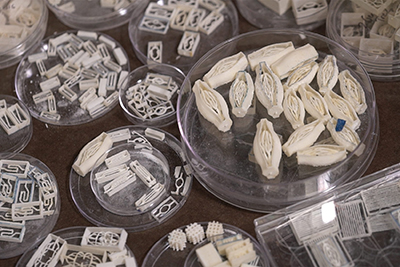
Image: A sample of blood-vessel templates that Rice University bioengineers 3D-printed using a special blend of powdered sugars. Image courtesy of B. Martin/Rice University
Balancing performance and the amount of media takes some work and knowing which parameters to consider. “Perfusion-optimized media should support high cell densities and at the same time allow for operations at low perfusion rates to reduce that media volume turnover,” Verlenden says. “Additionally, developing a formulation that meets these requirements and is in combination easy to hydrate and stable at room temperature is the key challenge.”
Overcoming the obstacles
With the challenges to developing media for perfusion culture in mind, what are the solutions? Overall, Verlenden says, “Developing media for perfusion requires an optimal balance of components to support the nutrient requirements during perfusion.” To accomplish this, a biomanufacturer should pursue strategies that “introduce components in adequately high concentrations in the optimal raw-material format,” Verlenden states. “Reliable screening systems, including strategies to analyze the outcome, are of prime importance when it comes to optimizing components.” The outcomes that manufacturers seek include a reliable growth profile, a low perfusion rate, and a high outcome of the desired product. As Verlenden describes it, “The final formulation would allow operation at a low perfusion rate and may provide additional benefits, such as improved protein titer in the production process, reduced effects of cell shear, and optimized growth rate.”
It’s worth taking on the obstacles around perfusion culturing, because it can be used in so many ways. As one example, Miller and his colleagues used perfusion-culturing techniques when creating engineered tissues that included a vascular network. In another example, John Eberth, associate professor of cell biology and anatomy at the University of South Carolina, and his colleagues used perfusion culturing to make a better coronary artery bypass graft (CABG) from the great saphenous vein (GSV). In this work, Eberth and his colleagues concluded: “We hypothesize that the mechanical properties of porcine GSV grafts can be favorably tuned for CABG applications prior to implantation using a prolonged but gradual transition from venous to arterial loading conditions in an inflammatory and thrombogenic deficient environment.”
The continuous nature of perfusion culture provides many benefits in bioprocessing. Making the most of this method, though, depends on optimizing the media for a specific application. As shown here, that’s not always easy, perfusion projects work better with media made for this application, as opposed to just using an existing mixture from batch methods. Once the media matches a perfusion process, many culturing applications can be improved, from manufacturing biotherapeutics to creating tissues for grafts.
What’s in the water?
Recently, I wrote about quantifying reagent-grade water for a variety of applications, including cell culture and concluded that scientists must rely on manufacturers to develop devices that make water that meets the needs of a particular application. In the cell culture world—and other applications that require water with the fewest contaminants—ultrapure water (UPW) makes a great choice.
Various vendors offer systems worth considering. As an example, MilliporeSigma offers platforms that make UPW and monitor the quality. Some devices, such as the arium mini plus UV from Sartorius, don’t even take up much more bench space than a coffee maker.
When making media for any culture, there’s a lot of water. To keep the media as chemically defined as possible, it helps to work with water that doesn’t add anything unexpected to the mix. That’s precisely the point of using UPW.