Central to the drug discovery workflow, compound management involves the logistics, storing, tracking, dispensing, and preparation of compounds to be tested and analyzed in drug discovery processes. Compound management must be handled flawlessly to avoid profound ripple effects that could ultimately impede the release of effective and viable therapeutics. Due to the impact of entering the wrong compound for testing or comparing inaccurate compound concentrations, compound management has become a major focus for biotech and pharmaceutical companies, large and small.
The importance of managing quality compounds
Efficient compound management is extremely important to the success of drug discovery, where throughput, speed, reliability, and traceability are fundamental. “Compound management is the heart of the drug discovery workflow,” says Lucia Bruzzone, application specialist at Tecan. “If compounds are not managed correctly, false results lead to repeated experiments, creating bottlenecks that cause a significant loss of time and money along with longer time-to-market periods.”
Meticulously tracking compounds, ensuring low variability, and capturing every step samples go through allows for quicker identification and more confident resolution of issues along the pipeline. “A primary rule of compound management is the need to know what compounds are available in what quantity and make sure that the right compound will be delivered at the right time in the right format and in the right condition,” explains Sylviane Boucharens, COO and co-founder at BioAscent.
Faulty compounds will ultimately generate flawed data, so providing high integrity compounds for every stage in the workflow is critical. Storing samples at the correct temperature, in a dark environment (to avoid photodegradation), and under dry air or nitrogen (to prevent water uptake/stock concentration fluctuations) can help ensure compound consistency and longevity. For compound tracking, safeguarding measures include the use of 2D barcodes and sample registration to confirm correct and accurate labeling. “When combining automated storage and 2D barcodes with a LIMS system, compound usage becomes fully traceable, such that new solubilized stocks can be ordered when volumes run low, freeze thaw cycles can be tracked, and the results of routine QC to investigate sample integrity using mass spectroscopy can be logged,” adds Paul Lomax, product manager for sample management at TTP Labtech.
Given these requirements and considering the vast number of potential compounds in a collection, compound management has become automation and equipment driven, offers Boucharens. Thus, companies need to invest in state-of-the-art equipment and infrastructure. While larger biotech and pharmaceutical companies can do this internally, smaller companies likely can’t afford to have the highest level of compound management. Thus, many turn to outsourcing to attain quality library maintenance. Companies like BioAscent bring capabilities to those that would not otherwise benefit from newer technologies. “Outsourcing services can be key to compound management success for many to gain the same advantage that larger companies have, including secure storage, traceability, and control, as well as compound preparation support since turnaround time can be critical,” says Mike Piper, chief commercial officer at BioAscent.
Another approach favored by smaller companies is to invest in compact modular automated storage systems such as TTP Labtech’s comPOUND, which provides scalable solutions for growing libraries and options for easy integration of more highly automated workflows as throughput increases.
Recent contributions for better integration and reliability
Boucharens believes that the future of compound management is in the ability to manage data and to collaborate across vendors to create full solutions. Conventionally, processes are very siloed, moving from one supplier to another in a disconnected fashion. There is a need to be able to communicate all information across the workflow in a compatible format and have the flexibility to integrate different data systems.
Many updated processes include capabilities for full integration of storage systems with sample processing workstations containing pipetting robots and/or acoustic transfer systems. “At any degree of process integration, automated storage systems increase overall efficiency and reliability while enabling users to focus attention on high-value activities,” says Donat Elsener, director of sales and marketing at Hamilton Storage. Newer systems are also providing the flexibility needed for smaller companies to benefit from system integration. The Verso automated storage system from Hamilton, for example, offers a variety of adaptable configurations, including an entry-level Verso SE series to suit fluctuating compound storage needs.
Automated storage systems reduce or eliminate risks and provide consistent and appropriate environmental conditions to protect samples from degradation or precipitation out of solution. “A management system like Verso tracks sample data, including type and location, so finding the right sample is quick and easy. User controls prevent unauthorized sample access, and integration with a LIMS system facilitates inventory management and ensures that proper levels are maintained at all times,” says Elsener.

Image: A view inside the Hamilton Verso, an automated sample storage system that can be used in compound management to increase overall efficiency and reliability while enabling users to focus attention on high-value activities.
Fully automated procedures can include compound weighing and dissolution, library maintenance, and assay plate preparation that radically improve drug discovery workflows by eradicating time-consuming and error-prone tasks. Bruzzone explains that by minimizing manual handling, labs can achieve more reliable and reproducible results as well as reduce any chance of compound mix-up while increasing the operator’s walk-away time. Automating these processes further enables managers to predict when steps will be completed, streamlining the drug discovery workflow throughout an entire organization.

With this level of support, and with comprehensive solutions incorporating superior precision and throughput, users can accomplish more and have confidence in their results. Automated solutions like Tecan’s Fluent® provide the speed and flexibility to move samples between different formats in an efficient and accurate manner. This liquid handling platform contains three arms that work in parallel across a dynamic work deck, offering increased plate capacity and boosting productivity. In addition, fully automated tube and microplate scanning is integrated to enhance process security and audit trails.
Image: Fully automated compound weighing station, barcode reading and flexible finger exchange system on Tecan’s Fluent automation workstation.
An efficient drug discovery workflow
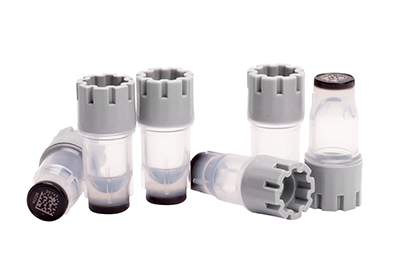
“Improving workflow efficiency represents an ongoing process in most organizations. One opportunity has arisen from the introduction of acoustic tubes for transferring compound directly from storage tubes to assay-ready plates,” explains Lomax. While this solution requires a significant capital investment in equipment, alternative lower cost solutions, such as the TTP Labtech mosquito tube, circumvent budget restrictions to provide low-volume assay-ready plate preparation directly from compound storage tubes. Mosquito tubes are used with TTP Labtech’s mosquito range of liquid handling robots for pipetting nanoliter to low microliter volumes and other commonly available automated liquid handlers for larger volumes.
BioAscent invested in acoustic dispensing to offer this technology to clients. Acoustic dispensing uses ultrasound to move droplets from plate to plate with no contact and no residual compound in pipettes. With serial dilutions, acoustic dispensing eliminates carryover issues and uses less compound overall. The technique helps improve the reproducibility and quality of data and is being used to standardize processes, including preparing compounds, plating, performing serial dilutions, and generating assay-ready plates. Implementing standardized processes such as this can minimize the difference between testing groups and maximize the reproducibility and comparability of experiments.
Image: TTP Labtech’s mosquito tubes (screw top)
Both acoustic and mosquito tubes remove an entire step from preparing assay-ready plates. Acoustic tubes are advantageous when directly replicating low nanoliter volumes of stored compounds into assay-ready plates, but serial dilutions are limited by dynamic range restrictions and higher volume dispensing is slow due to the necessity for multiple drops per well. Alternatively, the mosquito tube workflow cannot achieve the low nanoliter volumes of acoustic dispensing but offers speed advantages for higher volumes, plate to plate replications, or when serial dilutions are required for microplate preparations.
Compound management can significantly impact drug discovery workflows, causing unnecessary delays due to unsystematic and siloed processes. However, trending toward increasing efficiency with automation and step-by-step integration of data systems can protect samples and streamline compound management. Companies and labs benefit from these system improvements and services, enabling high-quality results that translate to the delivery of effective products.