As commercial and clinical cellular therapy products become more mainstream, there has been a renewed focus on each step of the cryopreservation process and the reagents being used. Substandard protocols and materials can lead to poor viability, batch variation, decreased cell functionality, as well as potential selection of cell subpopulations that may differ genetically or epigenetically from the original line. “With respect to cryopreservation in cell therapy, a major focus is to ensure reproducibility of freezing and thawing. Following cryopreservation all samples should be consistent with respect to viability and performance. There should be no variation either within a single batch or between batches frozen within the same facility or between different manufacturing sites,” says, Stuart Milne, CTO, Asymptote, Cytiva, formerly part of GE Healthcare Life Sciences.
Bringing cells from bench to bedside
“Developments in cell culture directly influence the advancements we see in cryopreservation,” says Nicole Wellens, senior product manager cell culture media at Lonza. This means that cryopreservation alongside cell therapies is moving toward serum-free media preferably chemically defined, trying to replace dimethyl sulfoxide (DMSO) with a less potentially harmful solvent, and switching to GMP (good manufacturing practices) compliant formulations.

“To date, although there have been attempts to replace the solvent, it remains the standard.” Because DMSO could have toxicity issues if injected into patients alongside cells, Wellens says that scientists have had to lower concentrations to less than 10% and utilize intensive washing steps to mitigate any side effects. She recommends using media specifically developed for cell and gene therapy applications such as the TheraPEAK™ X-VIVO™ in combination with TheraPEAK™ ProFreeze™ Freezing to ensure compliance.
Image: Technician cryopreserving vials in step down freezer. Image courtesy of Lonza.
Ann Rossi, senior bioprocess applications scientist at Corning Life Sciences, notes that a recent study boasts a new cryoprotectant-free method of ultrarapid cooling using inkjet cell printing that the scientists named superflash freezing (SFF). This causes “near-vitrification” of the cells. They speculate that the method should work for most cells including stem cells. But that may still be far off for most labs. However she says, “Even in some cell therapy applications, DMSO protocols are considered tried and true.” And Milne says, “DMSO is still the best material from a viability, recovery, and consistency perspective.” He sees many groups try to optimize away from the solvent over concerns regarding safety and the results usually fall short of the investment. He says the best way to reduce patient exposure while maintaining high cell viability is to increase the concentration of cells during the cryopreservation process. “Many CAR T manufacturers cryopreserve the final product at a cell concentration of 1 x 10⁸ cells/ml, reducing the absolute DMSO volume infused. At these concentrations, the cryopreserved cellular material is still widely spaced in the crystalline matrix and recovers well.”
As cell culture becomes more complex, so too do the hurdles to cryopreservation. Milne explains that cryopreservation of HTS (high throughput screening) plates presents a unique challenge. “We see increasing opportunities to use cryopreservation of HTS plates for screening applications. For example, primary liver cells are often the best way to determine toxicity of new compounds [or] drugs. The challenge is that batch-to-batch consistency of these cells/plates is poorly controlled. Using a cryopreserved batch of HTS plates from the same donor material is the optimal way to ensure experimental consistency throughout the development cycle of a drug.” He notes that Cytiva experts can help labs to optimize this process. And Wellens points out that increased usage of primary cells in 3D culture, particularly in drug discovery, cancer biology, cell therapies, and regenerative medicine, means that scientists must figure out how to deal with crystal formation from devitrification in organoids. “Researchers are exploring the use of hydrogel systems as conduits for cryopreservation. Although there have been indications that this could be a promising technique, further development is needed.”
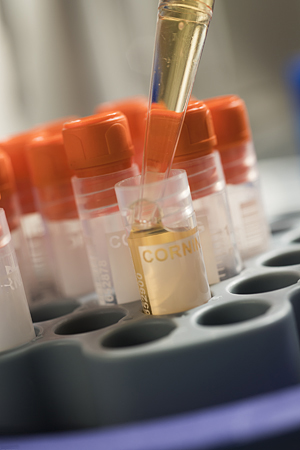
Labs are paying more attention to the quality of the cells being frozen down too, says Rossi, “especially when derived from precious patient samples.” She points out that many researchers are opting for commercially available cryopreservation media tailored to specific cell types. “These commercial cryopreservation media can often improve viability and recovery of cultures upon thaw. Many are also made to cGMP standards for therapy applications. And, there are DMSO-free options for sensitive cells.” Some examples include StemCell Technologies’s CryoStor series, Bulldog Bio’s Bambanker Cell Freezing Media, and Thermo Scientific's Recovery Cell Culture Freezing Medium.”
Image: Corning CoolCell alcohol-free cell freezing containers ensure standardized controlled-rate, -1°C/minute cell freezing in a -80°C freezer.
Scientists might consider conduction cooling instead of forced air or liquid nitrogen, says Milne, which ensures critical uniformity throughout the process. Cytiva carries a variety of liquid nitrogen-free cryogenic cold chain products. “The portfolio has been designed by cryobiologists to address the unique challenges presented by manufacture and distribution of cell and gene therapy products. Our products deliver controlled, consistent and digitally documented cryopreservation, logistics and thawing ... With a unified digital GMP-compliant record, manufacturers are able to streamline processes, see improved productivity, and scale safely.”
Sidestepping slip-ups
According to Rossi each step of the freeze and thaw process lends itself to many common mistakes. But sometimes a simple fix can go a long way. Here’s what the experts highlighted.
Harvesting and Processing: Rossi recommends freezing only the highest quality cells. Freezing and thawing can be rough on cells and sickly ones will not survive. “Common attributions of poor cultures include high passage number, cells out of the log phase of growth, cultures with mycoplasma or low levels of microbial contamination, cells exposed to dissociation reagents during harvest prior to freeze down, aggressive centrifugation to pellet cell prior to resuspension in cryoprotective media [and] adding the cryoprotectant too quickly to the cell suspension.”
Freezing: Rossi says the biggest mistake scientists make is getting the rate of freezing wrong. Wellens notes that cells should be cooled to 4° C before adding cryopreservation solution and that freezing should start as soon as the freezing medium is added: “Any delay could result in poor cell viability.” Freezing cells too quickly will cause undesirable intra and intercellular ice formation while freezing too slowly “will result in excessive cell dehydration, shrinkage, and subsequent cell death,” says Rossi. She adds that cells should be at an appropriate concentration; too few cells will make recovery difficult after thawing.
Storage: “The benefits of cryogenically storing cultures can only be realized if the cells are stored properly,” explains Rossi. “Temperatures below -130° C are required to protect cell viability,” says Wellens. And Rossi also points out that culture viability is usually negatively impacted when frozen cell vials fail to be transferred to a liquid nitrogen tank. Other non-liquid nitrogen options are available from Cytiva.
Thawing: Rossi says that the most common error here is thawing cultures too slowly and allowing contents to warm before diluting and removing cryoprotectant. Milne cautions, “When thawing material, ensure you wash/dilute DMSO before allowing the material to reach elevated (room) temperatures. Add buffer when material is [close] to the melting point, reducing DMSO concentration while the cellular metabolism is suppressed.” Rossi points out that centrifugation to rid cells of DMSO is not always necessary, Wellens adds in the case of certain cell types, like primary, may result in damage.
After the fact, Milne says that it’s normal to have a lot of variability post-thaw so researchers shouldn’t read too much into those data. It is far better to assess viability 24–48 hours post-thaw. “We often see teams trying to reinvent the wheel. We recommend, as a starting point, for you to adopt standard cryopreservation protocols. Invest resource[s] on your unique core competency, your cell lines, and planning for manufacturing scale-up.”