In the age of genomics, proteomics, and countless other omics, scientists and clinicians might expect a better batting average in finding new medicines, but that’s not the case. Most drug development programs still end in failure. That trend might turn around, if scientists could pick better targets—ones that can be validated as druggable. A variety of technologies, including genome-wide association studies (GWAS), promise more targets to consider, and hopefully better ways to pick the best ones.
At University College London, senior research associate Chris Finan and his colleagues stated that GWAS used to find single nucleotide polymorphisms (SNPs) associated with disease “could be explicitly interpreted as an under-used source of randomised human evidence to aid drug target identification and validation.”1 They added: “Fulfilling the potential of GWAS (and studies using disease-focused genotyping arrays) for drug development requires mapping disease- or biomarker-associated SNPs to genes encoding druggable proteins and to their cognate drugs and drug-like compounds.” The team estimated that nearly 4,500 human genes that encode proteins could be good targets for medicines.
A variety of companies are also deeply involved in developing new ways to identify and validate drug targets. Here are a few examples.
The state of the challenge
To get an idea of the ongoing challenge in finding the best targets, Biocompare asked several experts: What are the key challenges in target validation?
According to Michael Mouradian, director of robotics at Hamilton Company, “In order to produce viable drugs, pharmaceutical and biotechnology companies continue to devote significant time and resources to identify and validate molecular targets that are druggable.” He added, “The last 20 years of drug discovery and validation of therapeutic targets enabled rational design and established the developmental assay framework to ensure drugs are efficacious and safe.” Still, Mouradian sees ongoing challenges, including “complex experimental design, model availability, experimental reproducibility, throughput, and cost.”
“The biggest challenge is always the biology behind the targets,” Liusong Yin, director of antibody drug discovery at GenScript, explained. “There are many targets but few of them are druggable as the biology is complicated and many of the targets are involved in normal physiological processes.” As an example, he noted that tumor-specific antigens make good anticancer targets, but “usually we can only identify tumor-associated antigens, and therefore adverse effects are often associated with the therapies.” As for other challenges, he mentioned “generating appropriate material and/or models for various targets, and the target validation process should be relevant to physiological processes.”
Amanda Woodrooffe, vice president and general manager of U.K. operations/PHASEZERO research services team at BioIVT, agreed that many challenges arise from the complexity of biology. “Complex disease biology requires interrogation of multiple targets and cellular locations,” she said. “Pharmas are increasingly developing single therapeutic moieties that interact with multiple targets—for example, bi-specific and tri-specific biologics.” As scientists explore more target options, some of their characteristics also create challenges. For example, “newer disease targets are often low expression, which requires better sensitivity approaches,” Woodrooffe added.
Spreading specificity
As noted, some new medications take on more than one target. Yin calls this “the most exciting new advance in this area.” He added, “By combining two or more active components into one modality, we can take synergistic effects of multiple targets for reduced toxicity and enhanced efficacy, as well as reduced cost and better convenience to clients.”
Here, again, basic biology really matters. “By target validation, we understand better how the targets interact with each other and influence physiological outcomes,” Yin said. “Another thing is the advance in antibody and protein engineering, where we are capable of engineering various modalities, even though the immunogenicity concern is also increased due to over-engineering.”
Advances from automation
Scientists trying to zero in on better targets must often process more samples and generate more data in easier ways. Automation, said Mouradian, “allows the simplification of assay development for drug discovery and validation.”
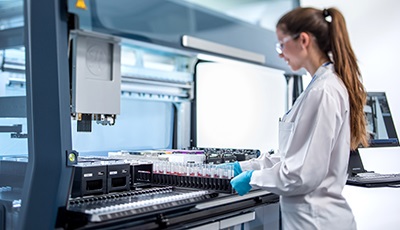
Different labs need different degrees of automation. Mouradian noted that Hamilton’s “Microlab VANTAGE Liquid Handling System is ideal for large laboratories and easily integrated with automated storage systems like the Verso from Hamilton Storage; on the other hand, our newest liquid handler, the Microlab Prep, is powerfully compact and ideal for smaller laboratories and even those working in biochemical safety cabinets.” Mouradian also said that “Pharmaceutical and biotechnology companies have shared with us that, by using Hamilton automation, they were able to reduce drug discovery and validation timelines for one validated drug target from four years to one year.”
Image: Automation can speed up target identification and validation in drug discovery. Image courtesy of Hamilton Company.
Building better models
To create better medicines, scientists need more realistic systems to study. The more that a model replicates nature, the more likely it can be used to develop medicines that make it all the way to patients.
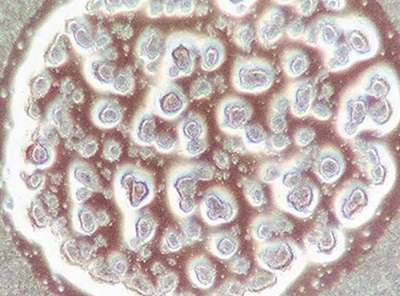
Consequently, Woodrooffe said that one of the most exciting new advances is: “The development of more relevant preclinical models, including complex tissue-like models built using human primary cells to support target/biomarker validation through to the selection of potential new medicines with the desired therapeutic effects and acceptable safety profiles.” As an example, BioIVT is developing a three-dimensional microtissue model of human liver fibrosis. Woodrooffe pointed out that this model is based on BioIVT’s “proprietary ORGANDOT platform,” and the model “provides robust function and longevity and is compatible with multiple endpoint assays to support specific target validation needs.”
Image: With the ORGANDOT platform, scientists at BioIVT are creating a 3D tissue model of human liver fibrosis. Image courtesy of BioIVT.
This is just one example of the improving collection of models that make better mimics of real physiology. “Progress with the development of more complex, organotypic, human primary cell-based models of disease allows the creation of a more relevant target environment, enabling a better understanding of the effects of novel therapeutics and target function in a human biology environment,” Woodrooffe explained.
Many targets remain to be explored. That alone creates lots of work to do. Plus, when scientists try to build medicines that target more than one thing at once, it gets even more complex. It remains to be seen if advances in technology can change biopharma’s results, maybe getting to a batting average that would be at least awful in baseball, even for a pitcher.
References
1. Finan, C; Gaulton, A; Kruger, FA; et al. The druggable genome and support for target identification and validation in drug development. Sci. Transl. Med. 2017. 9(383):eaag1166. [PMID: 28356508]