MicroRNAs (miRNAs) are small non-protein-coding RNAs that function as negative gene regulators. Recent evidence has shown that miRNA mutation or mis-expression correlates with various human cancers and indicates that miRNAs can function as tumor suppressors and oncogenes.
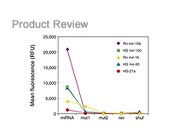
Our laboratory wanted to determine whether treatment of lung cancer cells with growth factors like EGF regulated the expression of miRNAs. We were interested in determining which miRNAs were up-regulated or down-regulated upon growth factor stimulation of A549 lung cancer cells. Quiescent A549 cells were treated with 100 ng/ml EGF for 48 hours and subsequently, total miRNA was isolated using the PureLink™ miRNA Isolation Kit from Invitrogen. The miRNAs were labeled using the miRNA Labeling Kit from Invitrogen and then hybridized on the Ncode™ Multi-species miRNA Microarray Kit, also from Invitrogen. This microarray kit contains five identical arrays, each contains a total of 1354 miRNA oligonucleotide probes. These include probes for human, mouse, rat, Drosophila, C.elegans and zebrafish miRNAs as well as positive controls and mismatch controls. The greatest advantage of the microarray is that it is easy to use. It does not require any expensive equipment or complex machinery. The protocol has been described in great detail in the technical manual. The manual also contains troubleshooting tips and an extensive bibliography. The key to the array is provided as a file which can be easily downloaded from Invitrogen’s website.
One drawback of the kit is its cost. The kit is very expensive. In addition to the microarray kit, you have to buy the hybridization chamber, the miRNA Isolation Kit, miRNA Labeling Kit as well as the miRNA controls to run the microarrays. If the cost of all these kits is totaled, the price of a running the whole kit is close to 1500 dollars, which may be out of budget for many laboratories. The kit contains 5 microarray slides, each of which is comprised of two duplicate subarrays. None of the solutions or the arrays can be re-used, so it is basically a single-shot procedure.
The biggest disadvantage of the array is that sometimes the signals of the duplicate arrays do not match. More than once, we have obtained a signal from one miRNA probe in one of the subarrays, whereas we did not get any signal from the duplicate subarray. Such lack of reproducibility is the biggest caveat of this kit since it makes critical interpretation of data a big challenge. We used the microarray kit for experiments involving another cell line and encountered similar problems. The technical support from the company has not been very helpful in this matter. Such variability between subarrays is most frustrating, especially when the kit is so expensive.
The Ncode™ Multi-species miRNA Microarray Kit facilitates high-throughput miRNA screening across many different species. However, the kit requires further standardization for optimal performance. I would advise all laboratories using these arrays to optimize them in their experimental system before running valuable samples. In summary, I would be hesitant to recommend this kit to researchers seeking novel miRNA molecular targets in cancer.
Postdoctoral Scientist
Drug Discovery
H. Lee Moffitt Cancer Center